Quick Answer
Should you sell an inherited Oahu home as-is or prepare it first?
If the estate has limited cash, selling as-is usually makes sense, since it avoids the estate fronting repair costs before there is any sale proceeds to draw from. Light, high-return preparation, cleaning, decluttering, and addressing any obvious safety issues, sometimes pays for itself even on a tight budget. Full renovations rarely make sense for a home the seller never plans to live in.
By Aksana Tupalskaya | September 1, 2026
This decision comes up in almost every inherited home sale, and the estate’s cash position usually decides it before the house’s condition does. An estate with cash on hand has more options than one that is waiting on the sale itself to cover any expenses.
When selling as-is is the right call
Selling as-is means listing the home in its current condition, without the estate spending money on repairs or updates before it goes to market. This preserves the estate’s cash, which matters when heirs are waiting on the sale to distribute proceeds or when there simply is not liquid cash available to front repair costs. It also moves faster, since there is no renovation timeline standing between the decision to sell and the day the home actually lists.
The tradeoff is straightforward: an as-is home usually sells for less than the same home after reasonable preparation, and some buyers will factor in a larger cushion for unknowns than the actual repair costs would justify. That gap is worth knowing about going in, not discovering after an offer comes in lower than expected.
When light preparation is worth it, even on a tight budget
Not all preparation requires real money. A thorough cleaning, clearing out remaining belongings, fresh landscaping, and addressing anything that reads as an obvious safety issue, like a broken railing or a visible roof leak, tend to have an outsized effect on how a home shows and how buyers perceive its overall condition. These are the items most likely to pay for themselves in the eventual sale price.
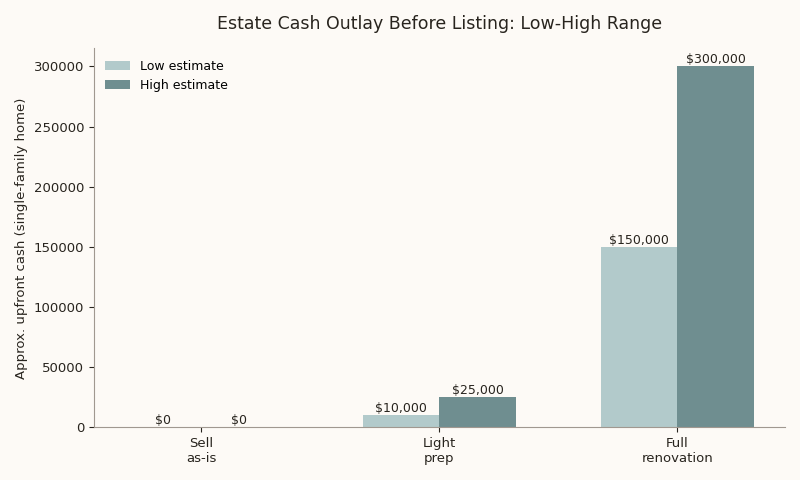
Be realistic about what “light” costs on this island before you commit to it. One coat of paint alone could run around $3,000 here for a single one-bedroom unit, and a light cosmetic pass across an entire single-family home, paint, cleaning, landscaping, and minor repairs, more realistically lands somewhere in the $10,000 to $25,000 range depending on the home’s size and condition, not a few thousand dollars.
A full renovation is a different order of magnitude entirely. Hawaii construction and renovation costs generally run about 1.5 to 1.7 times the national average because of shipping and specialized labor, and a whole-home renovation here typically runs somewhere between $50 and $150 per square foot depending on scope. For a mid-size single-family home, that puts a full renovation, kitchen and bathrooms included, realistically in the $150,000 to $300,000 range or more, not the tens of thousands some estimates suggest. That kind of investment carries real risk if the estate cannot recoup it, and Oahu buyers looking at a home that will need some updating usually price that expectation into their offer already.
Given costs like these, the goal is not to spend as little as possible or as much as possible, it is to spend on the specific items that will actually move the sale price, and skip the ones that won’t. That is not a decision to make from a national cost guide. Talk to a real estate agent who knows the Oahu market before you spend anything, walk the property together, and get contractor quotes on the two or three items most likely to pay for themselves rather than guessing. If it is easier, schedule a call and we can go through the property together and talk about what will actually generate the best return before you commit any of the estate’s cash.
What if the estate genuinely has no cash for any preparation?
This happens more often than people expect, particularly when the estate’s main asset is the house itself. A few options exist: selling fully as-is and letting the sale price reflect that, having heirs personally front a small amount for the highest-return items if they are willing and able, or, in some cases, working with the closing to have minor costs covered out of proceeds at close rather than upfront. Your agent and attorney can help structure whichever approach fits the estate’s specific cash position.
| Approach | Approx. Upfront Cash (Single-Family Home, Illustrative) | Typical Effect |
|---|---|---|
| Sell as-is | $0 | Fastest path, preserves cash, usually a lower sale price |
| Light prep (cleaning, paint, landscaping, minor safety fixes) | $10,000-$25,000 | Often improves buyer perception and offers relative to cost |
| Full renovation (kitchen and bathrooms included) | $150,000-$300,000+ | Hawaii construction runs roughly 1.5-1.7x the national average; rarely justified for a property the estate does not plan to occupy |
What this tells me as the numbers agent for Oahu sellers: on this island, the estates that come out ahead are usually the ones that spend selectively on the few things buyers actually notice, rather than assuming light prep is cheap or a full renovation is affordable, since both cost more here than the national numbers you’ll find online.
Frequently Asked Questions
Do buyers expect a disclosure statement for a probate sale the same way they would for a regular sale?
Hawaii has some disclosure requirements that can apply differently to a sale conducted by a personal representative than to a standard owner-occupied sale. Confirm the specific disclosure obligations for your transaction with your agent and attorney before listing.
Can the estate borrow against the expected sale proceeds to fund repairs?
Some heirs use inheritance or probate advance financing to access a portion of expected proceeds before closing, though these typically carry meaningful fees or interest and are worth comparing carefully against simply selling as-is before committing to one.
Is a pre-listing inspection worth paying for on an inherited home?
Often yes, even on an as-is sale, since it gives you an accurate picture of any major issues before a buyer’s inspector finds them, which can prevent a late renegotiation or a deal falling through closer to closing.
Does selling as-is mean accepting a lowball offer?
No. As-is describes the property’s condition at sale, not the price you have to accept. A well-priced as-is listing, properly marketed, can still generate competitive offers, particularly in a market where buyers are already expecting some homes to need updating.
If you are weighing whether to spend anything on preparation before listing an inherited Oahu home, that is exactly the kind of question worth a real conversation rather than a guess. Book a free 20-minute strategy call here, or read about what renting the home instead of selling would actually commit you to here.