

Quick Answer
Can you have two VA loans at once and buy on Oahu while keeping your mainland home?
Yes. The VA says the benefit can be used again even while you also have another VA-backed home loan. What changes is not your eligibility, it is your remaining entitlement, and that figure sets how much you can borrow here with no money down. Occupancy rules still apply to the new loan.
By Aksana Tupalskaya | October 31, 2026
I get this question most often from service members and veterans who already own somewhere else, are reporting to Oahu, and have been told by somebody at a barbecue that they used up their VA loan. Usually that is not true. Here is the actual mechanism, and the number that decides what you can buy.
What entitlement actually limits
Two different things get called a limit and only one of them is real for most buyers.
If you have full entitlement, the VA’s own words are that you do not have a loan limit, subject to being able to afford the loan and the appraisal supporting the price. That is it. There is no VA ceiling on the purchase price.
If you do not have full entitlement, because some of it is tied up in a loan you are keeping, then the county loan limit comes into play. The VA puts it this way: your remaining bonus entitlement is based on the county loan limit, minus the entitlement you have already used. The amount already used is on your Certificate of Eligibility, in the prior loans charged to entitlement table.
The other half of the rule is the lender’s, and it is the one that produces the actual number: most lenders require that your entitlement, your down payment, or a combination of both covers at least 25 percent of the total loan amount. So remaining entitlement times four is, roughly, the largest loan most lenders will do with nothing down.
The math, run on Hawaii’s number
The VA walks through this with a $900,000 county limit and $50,000 of entitlement already used: $900,000 times .25 is $225,000, minus the $50,000 already charged leaves $175,000 of remaining entitlement, and $175,000 times four is $700,000. That is the method, and it is the same arithmetic anywhere. Only the county figure changes.
Hawaii’s figure is much larger than the national one. The Federal Housing Finance Agency’s 2026 limits put the one-unit baseline at $832,750 for most of the country, and under the special statutory provisions that apply to Hawaii, the one-unit figure for Hawaii is $1,249,125. VA limits track the FHFA limits, so that is the number the calculation runs on here. Confirm your own county figure and your own entitlement with your lender and your Certificate of Eligibility before you rely on it, because a wrong input produces a confidently wrong answer.
| Step in the calculation | Figure | Source |
|---|---|---|
| The one-unit limit the calculation runs on | $1,249,125 for Hawaii in 2026 | FHFA 2026 conforming loan limit values |
| One-unit limit multiplied by .25 | $312,281 | The VA’s own method, applied to the Hawaii figure |
| Less the entitlement already charged | Your figure, from your Certificate of Eligibility | VA, prior loans charged to entitlement table |
| Remaining entitlement multiplied by four | The largest loan most lenders support with nothing down | VA, entitlement plus down payment must cover at least 25 percent |
| Example: $50,000 already charged | $262,281 remaining, supporting about $1,049,125 | Worked on the figures above |
What this tells me working with buyers using VA financing: entitlement is a dial rather than a yes or no, and every dollar of it sitting under your last house costs about four dollars of buying power on this one.
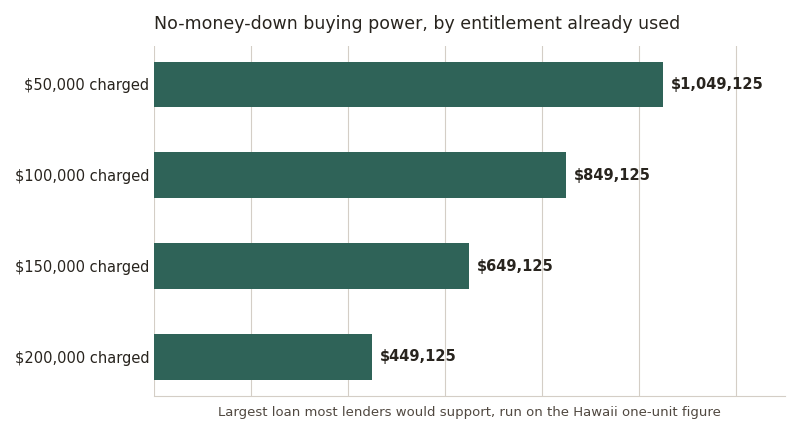
What the chart shows is the part that surprises people: every dollar of entitlement sitting under your old house costs you about four dollars of no-money-down buying power on the new one. That is the real price of keeping the mainland property, and it is a number you can weigh rather than a vague tradeoff.
Two things that are not in the arithmetic and matter anyway. A down payment can take you above the figure the entitlement alone supports, because the rule is entitlement plus down payment covering 25 percent, not entitlement alone. And if you paid off a previous VA loan in full, the VA may be able to restore that entitlement, which is a different and better position than having it charged.
What this means for what you can actually buy here
Three practical notes from the Oahu side of this.
Occupancy is not optional. The VA is direct about it: every VA loan must meet the occupancy requirements, a VA loan cannot be used to buy a vacation home or an investment property, and misrepresenting your intent to occupy could result in legal action. The second loan is for the home you are moving into. The first property becoming a rental is a separate question with its own tax consequences, which I went through in a post on what the tax bill does when you move off island and rent out your Oahu home.
Get the Certificate of Eligibility before you shop, not after you write an offer. The entitlement charged figure on it is the one input you cannot estimate, and in a multiple offer situation the difference between a pre-approval built on a real COE and one built on an assumption is the difference between a clean offer and a retrade.
If the number comes out short, an assumption is the other door. Taking over a seller’s existing low rate loan is a different route with a different constraint: instead of entitlement limiting the loan, the buyer covers the gap between the loan balance and the price. I laid out that gap math in covering the equity gap on an assumable Oahu loan. And if you are wondering whether a VA loan can be assumed by someone who is not a veteran, yes, with a consequence for the seller worth understanding first.
On timing, one thing I will say out loud because nobody else seems to: I will not ask you for your report date. Orders arrive with an approximate window and the date often does not firm up until weeks out, and people start looking long before either. Tell me roughly when you need to be in and I will work backward from that.
Frequently Asked Questions
Can I really hold two VA loans at the same time?
The VA says the benefit can be used more than once, and that this holds true even while you also have another VA-backed home loan. Entitlement tied to an existing VA loan does not automatically disqualify you. Your lender will want enough remaining entitlement to guarantee at least 25 percent of the new loan.
Do I have to sell my first house first?
Not necessarily, and that is the whole point of remaining entitlement. Selling and paying the loan off in full is what opens the door to having the entitlement restored, which is a stronger position, but it is not a precondition to buying again.
Where do I find how much entitlement I have used?
On your Certificate of Eligibility, in the prior loans charged to entitlement table, in the entitlement charged column. That figure is the input for the whole calculation, and it is worth pulling before you talk price with anyone.
Can I buy above the figure the math produces?
Yes, with a down payment. The requirement most lenders apply is that entitlement, down payment, or a combination covers at least 25 percent of the loan, so cash can make up the difference. The lender still has to approve the loan on the usual terms.
One last thing that is specific to buying here with a constrained number. Oahu has a standing set of listings carrying assumable low rate loans, and for a buyer whose entitlement is partly tied up, that pool is worth watching rather than guessing at. I refresh it from the MLS on the 1st and the 15th. You can get on the list at islandlivingoahu.com/assumable-list and I will send it to you as it updates.


