

By Aksana Tupalskaya | August 17, 2026
Quick Answer
How do you take over a seller’s low-rate mortgage on Oahu?
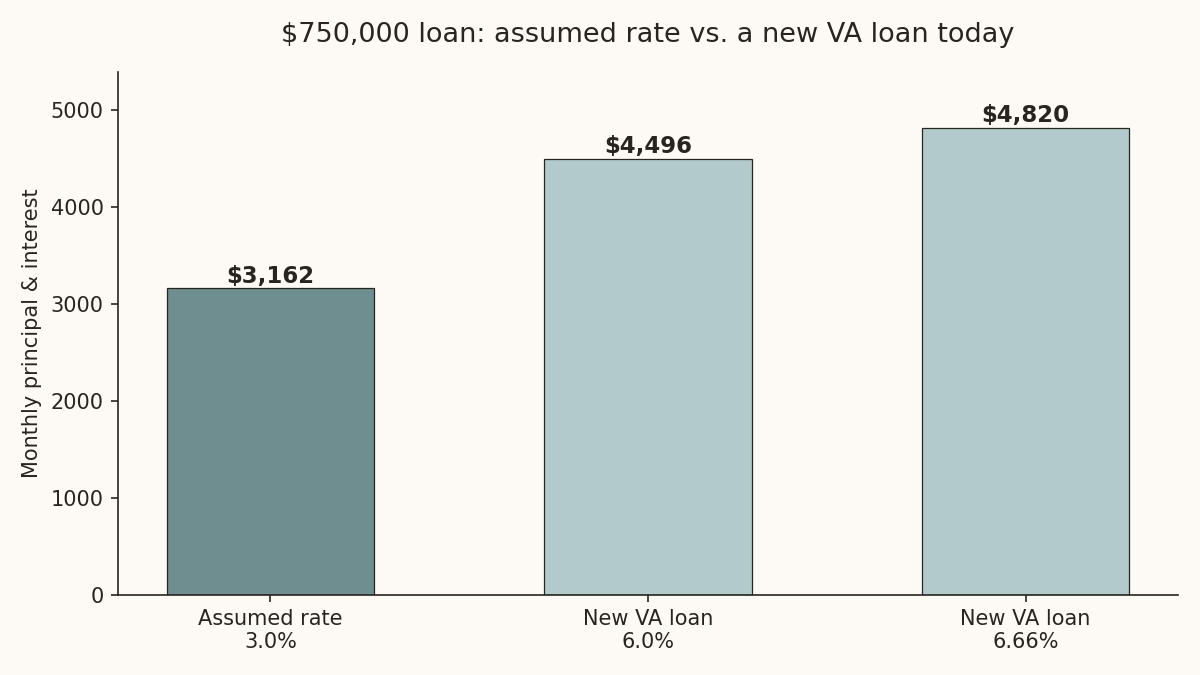
You assume a seller’s mortgage by qualifying with their loan’s servicer for the remaining balance at the existing interest rate, which on many Oahu listings right now sits well below current rates on a new loan. On a $750,000 VA loan assumed at 3.0%, the monthly payment runs about $3,162, versus roughly $4,496 on a new VA loan at 6.0%, a savings of about $1,334 a month. The assumption also comes with a reduced 0.5% VA funding fee instead of the usual 2.15%-3.3%. The buyer typically brings extra cash to cover the gap between the loan balance and the purchase price, and the process runs 3-6 months, longer than a standard purchase, so it needs to start early.
What the Numbers Actually Show
| What You’re Comparing | Figure | Source / Timeframe |
|---|---|---|
| $750,000 loan, assumed VA rate at 3.0% | $3,162/month | My Loan Assumption Guide, 2026 |
| $750,000 loan, new VA loan at 6.0% | $4,496/month (savings: $1,334/mo) | My Loan Assumption Guide, 2026 |
| $750,000 loan, new VA loan at 6.66% | $4,820/month (savings: $1,658/mo) | My Loan Assumption Guide, 2026 |
| VA funding fee, assumption vs. new loan | 0.5% assumed vs. 2.15%-3.3% new | My Loan Assumption Guide, 2026 |
What this tells me as the numbers agent for Oahu buyers: the rate spread alone is real money, and the funding fee discount on top of it is money most buyers don’t even factor in until I show them.
What “assuming” a mortgage actually means
Assuming a mortgage means you step into the seller’s existing loan, at their existing rate and remaining term, instead of originating a new loan of your own. Most conventional loans are not assumable. The loans that typically are: FHA and VA loans, both of which let a qualified buyer take over the loan under the program’s rules. FHA assumable listings are genuinely rare on Oahu right now, but they exist, and when one hits the MLS it tends to move fast.
You do not need to be a veteran to assume a VA loan, but you do need to qualify with the lender the same way any borrower would. If the buyer isn’t VA-eligible, the seller’s entitlement stays tied up in that loan until it’s paid off or refinanced, which is exactly why many sellers prefer a VA-eligible buyer when they have a choice. FHA loans have their own qualifying standards, generally more flexible on credit than a conventional refinance.
The funding fee discount most buyers don’t know about
Every new VA loan carries a funding fee of 2.15% to 3.3% of the loan amount, depending on down payment and whether it’s a first or subsequent use of VA benefits. An assumption carries a flat 0.5% funding fee instead, regardless of loan amount. On a $750,000 loan, that’s $3,750 to assume versus $16,125 to $24,750 to originate new. Veterans with a service-connected disability are exempt from the funding fee either way, but for everyone else, the assumption route is a five-figure difference before you even get to the rate savings.
Why the gap between the balance and the price matters most
The mortgage balance is almost never the same as the purchase price, and that gap is the real logistics problem in an assumption. On a $600,000 purchase price with a $500,000 assumable balance, a buyer needs roughly $100,000 in cash to bridge the difference, plus the 0.5% funding fee on the balance (about $2,500) and roughly 2% of the purchase price for insurance, taxes, and closing costs (about $12,000). All in, that example runs close to $114,500 in cash to close, not counting the lender’s separate assumption processing fee, which varies by servicer.
Some buyers ask about a second mortgage to cover that gap. It’s worth asking your lender, but many local credit unions have stopped offering second mortgages for VA assumptions, and where they still do, the combined loans typically can’t exceed 90% of the purchase price. In practice, it’s safer to target properties where you can cover the gap with your own cash reserves rather than count on stacking a second loan.
Steps in the assumption process
The process runs in a fairly fixed order: the seller accepts an offer, the seller’s agent notifies the loan servicer to start the assumption paperwork, both sides complete the lender’s and VA’s required forms, the buyer submits financial documents to prove eligibility, and both parties sign at closing, where the buyer pays the funding fee and any assumption costs. Expect 3-6 months start to finish. Sellers should plan for a longer wait before sale proceeds arrive, and both sides benefit from an agent who has actually run this process before, since not every servicer moves at the same pace.
Frequently Asked Questions
Can anyone assume a VA loan, or only veterans?
Anyone who qualifies with the lender can assume a VA loan. Non-veterans can assume, but the seller’s VA entitlement remains tied to the property until the loan is paid off, refinanced, or assumed by another veteran.
How much cash do I actually need for a VA loan assumption?
It depends on the gap between the purchase price and the remaining loan balance, plus the 0.5% funding fee and roughly 2% of the purchase price for other closing costs. On a $600,000 purchase with a $500,000 balance, that runs close to $114,500 all in. I’ll run the specific math for any listing you’re considering.
Does assuming a mortgage cost anything?
Yes. There’s the 0.5% VA funding fee on the assumed balance, plus the lender’s assumption processing fee, which varies by servicer, plus you’ll still need funds to cover the gap between the loan balance and the purchase price.
Want the full breakdown, including the mortgage payment examples at every rate tier and the step-by-step process? Get the free Loan Assumption Guide here, or get the free biweekly list of Oahu homes with assumable low-rate loans here.



