
Quick Answer
Can you assume a VA loan on Oahu as a non-veteran buyer?
Yes, a non-veteran buyer can assume a VA loan on Oahu. The caveat: the seller has to be willing, because for loans closed after March 1988, the seller’s VA entitlement stays tied up in that loan until it’s paid off, unless the buyer assuming it is also VA-eligible and formally substitutes their own entitlement. Many VA sellers only want a VA-eligible buyer for exactly this reason, though some are fine with the tradeoff and will accept a non-veteran buyer anyway. Either way, veteran or not, the buyer still has to qualify financially with the loan’s current servicer. The appeal is the rate: many Oahu VA loans in assumable inventory carry rates well under today’s market rate, and the buyer takes over that rate instead of financing at current terms.
By Aksana Tupalskaya | August 9, 2026
| What’s at Stake | Veteran (VA-Eligible) Buyer | Non-Veteran Buyer |
|---|---|---|
| Seller’s VA entitlement | Can be substituted, freeing the seller’s entitlement | Stays tied up until the loan is paid off |
| Typical seller preference | Preferred by most VA sellers | Often accepted, but not guaranteed |
| Servicer underwriting | Full assumption underwriting required | Same underwriting, plus the entitlement conversation |
| Rate inherited | Same current loan rate | Same current loan rate |
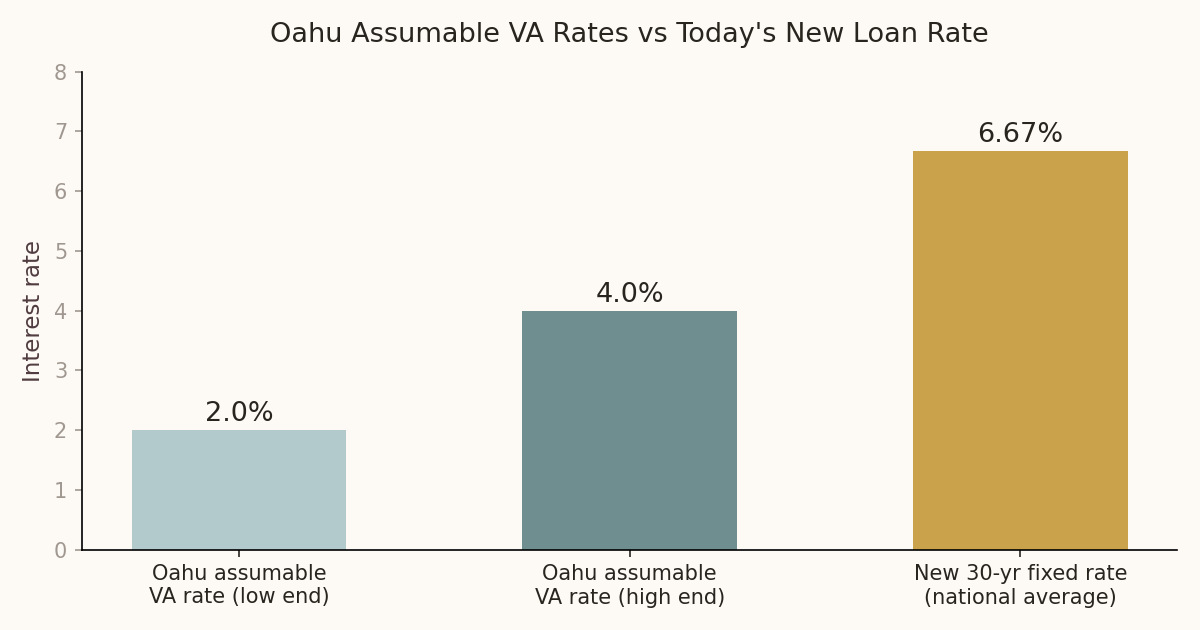
| Oahu assumable VA rates | Roughly 2-4%, per my MLS pull (twice monthly) | |
| New 30-year fixed rate (national) | 6.67%, Freddie Mac PMMS, Aug 13, 2026 | |
What this tells me as the numbers agent for Oahu buyers: the entitlement question is a seller preference, not a rule that disqualifies you, so it is worth asking before you assume the deal is closed to you.
This is one of the most common questions I get from buyers who’ve heard the word “assumable” and want to know if it’s actually open to them. The short answer is yes, but whether a specific seller says yes back depends on that entitlement caveat, and it’s worth understanding up front so you don’t waste time on an offer the seller was never going to accept.
What assuming a VA loan actually means
When you assume a loan, you’re not getting a new mortgage. You’re stepping into the seller’s existing one: same rate, same remaining term, same loan balance, at the servicer’s approval instead of a full new underwrite at today’s rate. On Oahu right now, that distinction matters a lot. Some assumable VA loans in the market carry rates set years ago that are meaningfully below where new loans price today.
To assume a VA loan, a buyer typically needs to:
- Apply for approval through the loan’s current servicer (this is a real underwriting process, not a formality)
- Meet the servicer’s credit and income requirements
- Cover the gap between the loan balance and the purchase price
That last point is the practical hurdle, and it’s where most deals actually get decided.
Why most VA sellers want a VA buyer
For loans originated after March 1988, if a non-veteran buyer assumes a veteran seller’s VA loan, the seller’s VA entitlement tied to that loan stays committed until the loan is paid off, unless the buyer is also VA-eligible and formally substitutes their entitlement. In plain terms: the seller doesn’t get their full VA entitlement back to use on a future purchase right away if the buyer taking over the loan isn’t also a veteran.
That’s why most VA sellers prefer, or outright require, a VA-eligible buyer. It’s not a rule that blocks non-veteran buyers from assuming the loan, it’s the seller’s own incentive to protect their entitlement. Some sellers are fine assuming that tradeoff, especially if they’re not planning to buy again with a VA loan soon. Others will only entertain offers from veteran buyers for exactly this reason. This is a real conversation to have with the seller and their agent early, before you spend time underwriting a deal that the seller was never going to accept from a non-veteran buyer.
The gap financing reality: cash is more prevalent than a second loan
If a home is priced well above the remaining loan balance, you need a way to cover that difference, and this changes the math on whether assuming is actually the better deal versus a new loan. In the past, buyers sometimes covered that gap with a second loan. In practice, that second loan sits as a second lien on the property, and we’re seeing lenders get more cautious about financing it. Cash is the more prevalent way buyers are covering the gap right now. If you don’t have that cash available, run the numbers carefully before you get attached to a specific assumable listing.
Why this matters more on Oahu than most markets
Oahu has a meaningful concentration of VA loans given the military presence here, which means a real, ongoing supply of assumable inventory, updated as new listings hit the MLS. There are typically 100+ Oahu homes at any given time, across single-family, condo, and townhome, where a buyer can step into the seller’s existing loan instead of taking out a new one, some of them locked in at rates in the 2-4% range (109 listings as of my September 5, 2026 pull). I pull that full list from the MLS twice a month.
What to check before you write an offer on an assumable listing
- Confirm the loan is actually assumable and get the current balance and rate from the listing agent or seller
- Ask directly whether the seller requires the assuming buyer to be VA-eligible, before you invest time in the offer
- Talk to the servicer early. Assumption approval timelines can run longer than a standard purchase loan, which affects your closing date
- Have a real plan for the gap between the loan balance and the purchase price, and know that cash is the more common route right now
- If you’re a veteran yourself, ask about substituting your own entitlement so the seller’s is released
Every situation is different, and the only way to know if a specific assumable listing pencils out for you is to run the numbers on that loan and that price together.
Frequently Asked Questions
Do I have to be a veteran to assume a VA loan?
Not always, but many VA sellers prefer or require it, because assuming the loan with a non-veteran buyer keeps the seller’s VA entitlement tied up until the loan is paid off. Some sellers accept that tradeoff and allow non-veteran buyers to assume anyway.
What happens to the seller’s VA entitlement if a non-veteran assumes their loan?
For loans closed after March 1988, the seller’s entitlement tied to that loan generally stays committed until the loan is paid off, unless the buyer is also VA-eligible and substitutes their own entitlement. This is worth discussing directly with the servicer and the seller.
How do buyers usually cover the gap if the home price is higher than the loan balance?
Cash is the more common route right now. A second loan is possible but sits as a second lien on the property, and financing for that has gotten harder to secure.
How long does a VA loan assumption take to close?
It varies by servicer, but assumption approval can take longer than a standard purchase loan underwrite. Start the servicer conversation as early as possible in your offer process.
Where can I find Oahu listings with assumable loans?
Assumable loan status isn’t always obvious from a standard listing search. There are typically 100+ Oahu homes with an assumable loan at any given time (109 as of my September 5, 2026 pull), and I track and publish that updated list twice a month, straight from the MLS.
The bottom line on assumable VA loans
Whether a non-veteran buyer can assume a specific VA loan comes down to the seller’s own entitlement situation, not a blanket rule. What matters is whether the seller is willing, whether you qualify with the servicer, and whether you can bridge the gap between the loan balance and the purchase price, most likely in cash.
I cover the full mechanics of assuming a loan on Oahu, VA and otherwise, in my Loan Assumption Guide 2026, free to download.
Want the free biweekly list of every Oahu home with an assumable loan, single-family, condo, and townhome? Get it at islandlivingoahu.com/assumable-list.



