
Quick Answer
How do you choose the best realtor to sell your home on Oahu?
Choose an Oahu listing agent by testing four things: how they arrive at your price, whether they market beyond the island, how they handle HARPTA withholding if you live out of state, and whether they will tell you not to list when the timing is wrong. Ask each agent to show the closed sales behind your number, adjusted for the credits sellers gave buyers at closing. Agents who price from list prices rather than real net figures tend to overshoot, and overpriced homes take cuts.
What the Numbers Actually Show
| Market Indicator | Figure | Source / Timeframe |
|---|---|---|
| Closed sales reviewed | 66 sales, Hawaii Kai & Kailua | My monthly sold report, July 2026 |
| Total seller credits given back at closing | $85,056 | My monthly sold report, July 2026 |
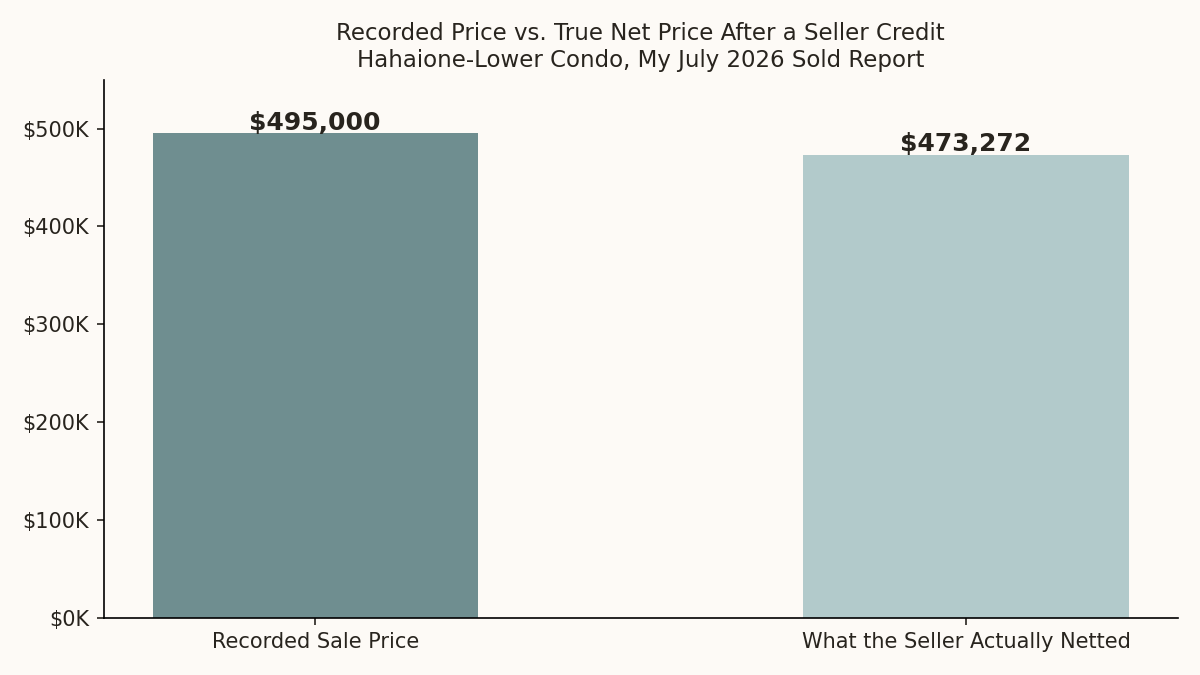
| Largest single credit found | $21,728 (Hahaione-Lower condo) | My monthly sold report, July 2026 |
| Recorded price vs. true net on that sale | $495,000 recorded / $473,272 net | My monthly sold report, July 2026 |
What this tells me as the numbers agent for Oahu sellers: the agent who catches a $22,000 gap before you price the listing is the agent who prevents the accidental overpricing that leads to a stale listing and a cut.
Start with the number, not the pitch
Most listing appointments follow the same shape. An agent arrives, praises your home, presents a price, and asks for the signature. You are left comparing three confident people who all sounded reasonable.
Here is a better filter. Ask each of them one question: show me the sales you used, and tell me what those sellers actually netted.
That question is hard to fake. List prices are opinions, and even recorded sale prices can mislead on Oahu, because the credit a seller hands back at closing often does not appear in the public record. A home recorded at $1.4 million where the seller credited the buyer $40,000 did not really trade at $1.4 million. Price your home against a stack of numbers like that and you will start high, sit, and cut.
An agent who has that data will show it to you without being asked twice. An agent who does not will change the subject to marketing.
The four questions that actually separate agents
1. How did you get to this price?
You are listening for closed sales, adjusted for credits, in your specific area and price band. Be wary of a number that arrives with no arithmetic behind it, and be equally wary of the highest number in the room. Some agents buy the listing with an optimistic price and renegotiate you downward three weeks later, once your home has gone stale.
2. Where will my home be marketed, and to whom?
A meaningful share of Oahu buyers do not live here when they buy. They never drive past your sign or walk your open house. They find your home because someone put it in front of them in California, Washington, or Texas.
Ask for specifics. “The MLS and social media” is not a plan. You want to hear about targeting, about where the buyers for your price point actually come from, and ideally about video, because that is what travels.
3. If I live out of state, how will you handle HARPTA?
Hawaii withholds a percentage of the gross sale price from non-resident sellers at closing. It is generally refundable in whole or part when you file, but it changes what lands in your account on closing day.
The failure mode is almost never the rule. It is discovering the rule days before closing. A strong agent raises it during the listing conversation, unprompted. Whatever any agent tells you, confirm the specifics with your CPA or tax professional, because agents are not tax advisors and your situation may differ.
4. Is now actually the right time?
Every neighborhood runs a demand cycle. List into a peak and momentum works in your favor. List into a trough and days on market climb, and once buyers see a listing sitting, the question changes from whether they can get it to what is wrong with it.
An agent willing to say “wait until spring” is telling you something valuable, because that sentence costs them money. It is one of the strongest trust signals available to you, and you will rarely hear it.
What to be careful about
Two patterns cost Oahu sellers real money.
The highest price wins the listing. Price is the easiest thing for an agent to compete on and the easiest promise to walk back. Compare method, not optimism.
Mainland habits applied to Hawaii. Hawaii is an escrow state with its own purchase contract, conveyance tax tiers, a seller disclosure with a firm deadline, and leasehold ownership that barely exists elsewhere. Ask directly about leasehold versus fee simple. Vagueness there is a real warning sign.
One more thing worth knowing: preparation should not cost you money upfront. Staging, professional photography, and marketing are investments a listing agent makes in your sale and recovers at closing. If an agent asks you to fund that before you have sold anything, ask why.
Frequently asked questions
What should I ask a realtor before listing my Oahu home?
Ask how the price was calculated and whether seller credits were factored in, where the home will be marketed and to which buyers, who pays for staging and photography, how HARPTA will be handled if you are a non-resident, and whether the timing is actually right.
Should I choose the agent who quotes the highest price?
Usually not. The listing price is set by the seller, but the sale price is set by the market. An inflated list price tends to produce a stale listing and a price cut, which typically nets less than pricing correctly at the start.
Does it matter if my agent is local to Oahu?
Yes, more than in most markets. Hawaii’s escrow process, conveyance tax schedule, seller disclosure timing, leasehold ownership, and HARPTA withholding are state-specific and do not follow mainland norms.
Can I sell my Oahu home if I live on the mainland?
Yes. Remote sales are routine here, and a large share of Kailua, Hawaii Kai, and East Honolulu owners live elsewhere. What matters is an agent set up to run the process remotely and to plan for HARPTA in advance rather than at the closing table.
How long does it take to sell a home on Oahu?
Escrow typically runs 30 to 45 days once you are under contract, but total time depends on pricing and season. Homes priced to real closed data generally move fastest; homes priced to optimism take a cut first and take longer.
Where this leaves you
The best listing agent for your home is the one who shows their work before you hire them, not after. If the numbers exist where you can see them without booking an appointment, that tells you most of what you need to know.
Want to see what homes in your neighborhood actually sold for after credits? Get the free monthly sold report HERE.
the best realtor to sell your home on Oahu?
Choose an Oahu listing agent by testing four things: how they arrive at your price, whether they market beyond the island, how they handle HARPTA withholding if you live out of state, and whether they will tell you not to list when the timing is wrong. Ask each agent to show the closed sales behind your number, adjusted for the credits sellers gave buyers at closing. Agents who price from list prices rather than real net figures tend to overshoot, and overpriced homes take cuts.
By Aksana Tupalskaya | August 7, 2026
Start with the number, not the pitch
Most listing appointments follow the same shape. An agent arrives, praises your home, presents a price, and asks for the signature. You are left comparing three confident people who all sounded reasonable.
Here is a better filter. Ask each of them one question: show me the sales you used, and tell me what those sellers actually netted.
That question is hard to fake. List prices are opinions, and even recorded sale prices can mislead on Oahu, because the credit a seller hands back at closing often does not appear in the public record. A home recorded at $1.4 million where the seller credited the buyer $40,000 did not really trade at $1.4 million. Price your home against a stack of numbers like that and you will start high, sit, and cut.
An agent who has that data will show it to you without being asked twice. An agent who does not will change the subject to marketing.
The four questions that actually separate agents
1. How did you get to this price?
You are listening for closed sales, adjusted for credits, in your specific area and price band. Be wary of a number that arrives with no arithmetic behind it, and be equally wary of the highest number in the room. Some agents buy the listing with an optimistic price and renegotiate you downward three weeks later, once your home has gone stale.
2. Where will my home be marketed, and to whom?
A meaningful share of Oahu buyers do not live here when they buy. They never drive past your sign or walk your open house. They find your home because someone put it in front of them in California, Washington, or Texas.
Ask for specifics. “The MLS and social media” is not a plan. You want to hear about targeting, about where the buyers for your price point actually come from, and ideally about video, because that is what travels.
3. If I live out of state, how will you handle HARPTA?
Hawaii withholds a percentage of the gross sale price from non-resident sellers at closing. It is generally refundable in whole or part when you file, but it changes what lands in your account on closing day.
The failure mode is almost never the rule. It is discovering the rule days before closing. A strong agent raises it during the listing conversation, unprompted. Whatever any agent tells you, confirm the specifics with your CPA or tax professional, because agents are not tax advisors and your situation may differ.
4. Is now actually the right time?
Every neighborhood runs a demand cycle. List into a peak and momentum works in your favor. List into a trough and days on market climb, and once buyers see a listing sitting, the question changes from whether they can get it to what is wrong with it.
An agent willing to say “wait until spring” is telling you something valuable, because that sentence costs them money. It is one of the strongest trust signals available to you, and you will rarely hear it.
What to be careful about
Two patterns cost Oahu sellers real money.
The highest price wins the listing. Price is the easiest thing for an agent to compete on and the easiest promise to walk back. Compare method, not optimism.
Mainland habits applied to Hawaii. Hawaii is an escrow state with its own purchase contract, conveyance tax tiers, a seller disclosure with a firm deadline, and leasehold ownership that barely exists elsewhere. Ask directly about leasehold versus fee simple. Vagueness there is a real warning sign.
One more thing worth knowing: preparation should not cost you money upfront. Staging, professional photography, and marketing are investments a listing agent makes in your sale and recovers at closing. If an agent asks you to fund that before you have sold anything, ask why.
Frequently asked questions
What should I ask a realtor before listing my Oahu home?
Ask how the price was calculated and whether seller credits were factored in, where the home will be marketed and to which buyers, who pays for staging and photography, how HARPTA will be handled if you are a non-resident, and whether the timing is actually right.
Should I choose the agent who quotes the highest price?
Usually not. The listing price is set by the seller, but the sale price is set by the market. An inflated list price tends to produce a stale listing and a price cut, which typically nets less than pricing correctly at the start.
Does it matter if my agent is local to Oahu?
Yes, more than in most markets. Hawaii’s escrow process, conveyance tax schedule, seller disclosure timing, leasehold ownership, and HARPTA withholding are state-specific and do not follow mainland norms.
Can I sell my Oahu home if I live on the mainland?
Yes. Remote sales are routine here, and a large share of Kailua, Hawaii Kai, and East Honolulu owners live elsewhere. What matters is an agent set up to run the process remotely and to plan for HARPTA in advance rather than at the closing table.
How long does it take to sell a home on Oahu?
Escrow typically runs 30 to 45 days once you are under contract, but total time depends on pricing and season. Homes priced to real closed data generally move fastest; homes priced to optimism take a cut first and take longer.
Where this leaves you
The best listing agent for your home is the one who shows their work before you hire them, not after. If the numbers exist where you can see them without booking an appointment, that tells you most of what you need to know.
Want to see what homes in your neighborhood actually sold for after credits? Get the free monthly sold report HERE.