
By Aksana Tupalskaya | August 17, 2026
Quick Answer
What is a CPR property on Oahu, and why do some sell better than others?
CPR stands for Condominium Property Regime, a Hawaii-specific way to legally split one parcel of land into two or more separately owned homes without subdividing the lot itself. A current Coconut Grove, Kailua example lists two CPR units on one lot for a combined $2,749,000, and off-market history in that same pocket shows CPR pairs selling smoothly, sitting unsold, and getting repriced before finally closing, all on similar-looking lots. Whether a CPR listing sells well usually comes down to how the units are priced relative to each other, not the CPR structure itself.
What the Numbers Actually Show
| Market Indicator | Figure | Source / Timeframe |
|---|---|---|
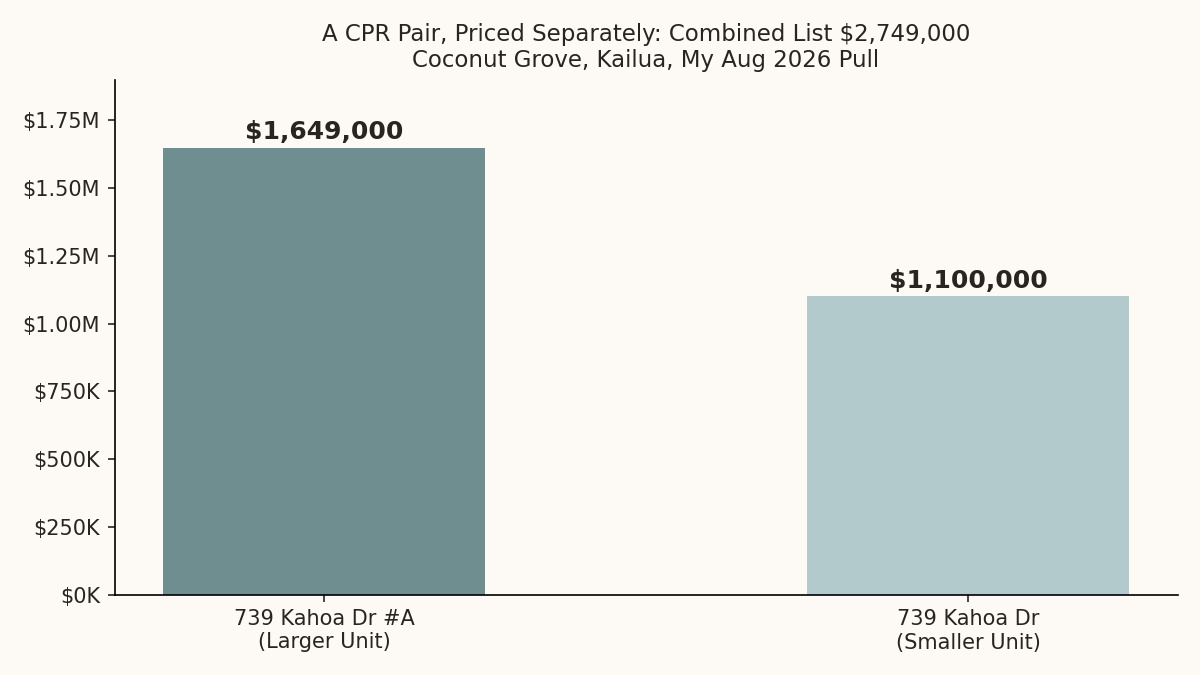
| 739 Kahoa Dr #A, Coconut Grove (larger unit) | Listed at $1,649,000 | My MLS pull, Aug 2026 |
| 739 Kahoa Dr, Coconut Grove (smaller unit) | Listed at $1,100,000 | My MLS pull, Aug 2026 |
| Combined list price for the CPR pair | $2,749,000 | My MLS pull, Aug 2026 |
| Coconut Grove months of supply | About 2.6 months | My MLS pull, Aug 2026 |
What this tells me as the numbers agent for Oahu sellers: two units on one lot need two separate, honest comps, not one price split down the middle.
What a CPR actually is, in plain terms
Most people picture a condo building when they hear “condominium,” but a CPR is a legal tool, not a building type. It lets an owner take one lot and create two or more separately deeded, separately owned homes on it, without going through a full subdivision. On Oahu, where usable land is limited and subdivision approval can be slow, CPRs are a common way to add housing on an existing lot, especially in older neighborhoods like Kailua’s Coconut Grove where lots were platted decades before current zoning made this the more practical path.
Each CPR unit gets its own deed and can be bought, sold, or financed independently. What ties them together is the underlying lot and often a simple CC&R agreement between the owners covering shared driveways, utility easements, or setbacks. This is different from a standard condo association: there is usually no large HOA, no shared amenities, and no monthly dues beyond whatever the two owners agree to split.
Why some CPR pairs sell smoothly and others don’t
Coconut Grove has enough CPR history now to show a real pattern. Some pairs sell without much friction, both units moving within a normal timeframe. Others sit for months before a price cut finally gets one or both units under contract. A few have failed to sell at all and come back on the market repriced, sometimes more than once.
The difference is rarely the CPR structure itself. It is almost always relative pricing between the two units and how each is positioned against the neighborhood’s other active listings. A larger unit priced too close to the smaller one’s value, or two units priced as if they were each standalone homes on a full lot, tends to sit. Buyers comparing a CPR unit against a true single-family listing are pricing in the shared-lot tradeoff whether or not the seller accounted for it.
Financing is the other variable worth checking early. Lenders sometimes treat CPR units differently than a standard single-family home, and VA and conventional approval can depend on how the CC&R is written. A CPR unit that looks like a great deal on paper can stall in escrow if financing wasn’t confirmed before the offer went in.
What this means if you’re buying or selling a CPR unit
As a buyer, ask to see how the other unit on the lot is priced and whether it has sold recently, since that comparable tells you more than a generic neighborhood comp will. As a seller, price relative to the sister unit and to true single-family comps, not just to other CPRs, since Coconut Grove’s off-market history shows buyers do that comparison whether you invite it or not.
Frequently Asked Questions
Is a CPR unit the same as a condo?
Legally it uses the same regime, but functionally most CPR pairs on Oahu look and live like separate single-family homes sharing one lot, not units in a condo building with shared amenities.
Does a CPR unit have HOA dues?
Usually not a formal HOA. Owners typically split limited shared costs directly, defined in the CC&R, rather than paying into a managed association.
Is it harder to get a loan on a CPR unit?
It can be, depending on the lender and how the CC&R is structured. Confirm financing early in the process rather than assuming a CPR unit will qualify the same way a standalone home does.
Want to see what homes in your neighborhood actually sold for after credits? Get the free monthly Kailua & Hawaii Kai sold report here.