

Quick Answer
Why does the date-of-death value matter when you sell an inherited Oahu home?
Under federal tax law, an heir’s cost basis in inherited property generally becomes its fair market value on the date the previous owner died, a rule called the stepped-up basis. If you sell soon after inheriting, your taxable gain is measured from that date-of-death value, not from whatever the original owner paid decades ago, which is why many heirs owe far less capital gains tax than they assume.
By Aksana Tupalskaya | September 1, 2026
This is one of the most misunderstood parts of inheriting Oahu real estate, and the confusion usually runs in the wrong direction. Most people assume selling an inherited home triggers a large tax bill on decades of appreciation. Often it does not, and the reason is a provision in the tax code most heirs have never heard of until they need it.
What stepped-up basis actually means
Basis is the number the IRS uses as your starting point for calculating gain or loss on a sale. If you buy a home yourself, your basis is generally what you paid for it. If you inherit a home, the rule is different: under IRC Section 1014, your basis generally becomes the property’s fair market value on the date the previous owner died, not what they originally paid.
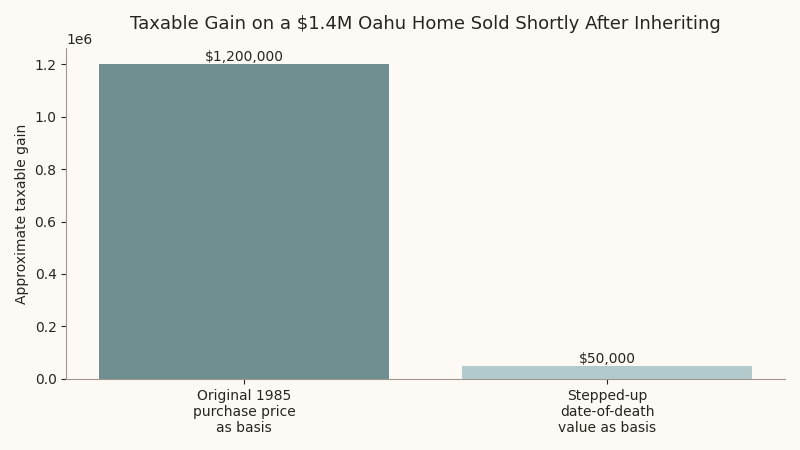
Say a parent bought an Oahu home in 1985 for $200,000. Today it is worth $1.4 million. If basis carried over unchanged, an heir who sold it would show roughly $1.2 million of taxable gain. With the stepped-up basis, the heir’s basis is close to $1.4 million, the value on the date of death, so a sale shortly after inheriting can show a gain of only a small fraction of that.
This is exactly the situation that keeps heirs from listing a home they are afraid to sell. The tax bill they are picturing is often not the tax bill that actually exists.
How the date-of-death value actually gets established
The stepped-up basis is only as reliable as the number behind it. A personal representative is required to file an inventory of the estate’s assets, including real property, within three months of appointment under Hawaii law, and that inventory lists the fair market value of each item as of the date of death. That inventory value is frequently the number a CPA later uses as the heir’s basis.
If a proper appraisal was never done near the date of death, it is still possible to obtain a retrospective, or date-of-death, appraisal from a qualified appraiser after the fact. A real estate agent’s comparative market analysis is useful for pricing a listing, but it is not the same document a CPA or the IRS wants standing behind your basis. Get the two roles straight before you need the number defended.
| Scenario | Basis Used | Approx. Taxable Gain on a $1.4M Sale |
|---|---|---|
| Basis carried over from 1985 purchase | $200,000 (1985 purchase price) | ~$1,200,000 |
| Stepped-up basis at date of death | ~$1,400,000 (date-of-death value) | ~$50,000 (illustrative) |
What this tells me as the numbers agent for Oahu sellers: the fear of a large tax bill is usually built on the wrong basis number, and getting the date-of-death value properly documented is worth more to most heirs than any repair or upgrade to the house itself.
Where this gets more complicated
A few situations change the math, and they are worth flagging rather than glossing over.
- Jointly held property between non-spouses. If siblings inherited the home together as joint tenants and one later passes, generally only the deceased co-owner’s share receives a new step-up, while the surviving co-owner’s original share keeps its prior basis. This gets complicated quickly and is worth confirming with a CPA for your specific ownership structure.
- HARPTA withholding still applies to the full sale price. Hawaii’s 7.25% withholding on a property sale by an out-of-state seller is calculated on the amount realized, not on your actual gain. A low or zero taxable gain does not exempt you from withholding automatically. You generally still need to file Form N-288B, at least 10 working days before closing, to have the withholding reduced to match your real numbers.
- No appraisal exists from the date of death. This is common, especially when a parent passed unexpectedly. A retrospective appraisal can still establish that value years later, using historical sales data from around that date.
What this means if you are deciding whether to sell
The tax question and the timing question are related but separate. Whether you sell now or later changes how much additional appreciation gets taxed on top of the stepped-up basis, since only appreciation after the date of death is taxable gain to you. It does not change the stepped-up basis itself. A CPA can walk through your specific numbers before you decide anything, and that conversation costs far less than guessing wrong.
Frequently Asked Questions
Does the stepped-up basis apply to a mortgage still owed on the home?
The stepped-up basis applies to the property’s value, not to any debt against it. If the estate assumes or pays off a mortgage, that is handled separately in the estate’s accounting and does not change your basis in the property itself.
What if the home was gifted before death instead of inherited?
A lifetime gift does not get a stepped-up basis. The recipient generally takes over the giver’s original basis. This is a meaningfully different outcome than inheriting the same property after death, and it is one reason gifting Oahu property during life needs its own conversation with a CPA.
Do I need a new appraisal even if the estate already has one from the inventory filing?
If the personal representative already obtained a qualified appraisal at or near the date of death for the probate inventory, that appraisal may be sufficient. Confirm with your CPA that it meets the documentation standard for your basis, since inventory values are sometimes based on assessed value rather than a full appraisal.
Does this change if I decide to rent the home instead of selling it right away?
Your basis stays the same either way, but if you rent the property first, depreciation you claim while renting reduces your basis before an eventual sale, which affects your gain calculation later. That is a separate set of rules worth reviewing with a CPA before you decide between selling and renting.
This is exactly the kind of question worth running past a CPA before you list, not after. If you want to talk through the timeline for your specific inherited Oahu property, book a free 20-minute strategy call here. You can also read more about what happens first when you inherit a home from the mainland here.



