
Quick Answer
What does it cost to hold an empty, inherited Oahu home every month?
An empty inherited home on Oahu keeps costing money even though nobody is living in it. Property tax continues to accrue and can increase if the home’s exemption status changes, insurance often costs more once it is classified as vacant, and there are still baseline utility and upkeep costs. On a mid-range Oahu home, this can run somewhere in the neighborhood of $800 to $1,000 or more a month, depending on the property.
By Aksana Tupalskaya | September 6, 2026
Deciding whether to sell, rent, or hold an inherited home rarely happens overnight, and every month that decision takes usually has a real dollar cost attached to it, even when nobody has moved in and nothing visible is happening at the property.
Property tax does not pause for probate
This is the cost heirs are most likely to overlook. The home exemption that reduced the previous owner’s property tax was tied to them personally living in the home as their primary residence. Once that is no longer the case, the exemption generally needs to be reported and removed, and the home is taxed at Oahu’s standard residential rate going forward. If the home’s assessed value sits at or above $1,000,000 with no exemption on file, it can be reclassified into Oahu’s Residential A tax class, which carries a meaningfully higher rate above the first million in assessed value than standard residential property.
Confirm directly with the City and County of Honolulu’s Real Property Assessment Division what applies to your specific property and timeline. This is not something to guess at, since getting it wrong in either direction, assuming the exemption still applies or assuming Residential A automatically kicks in, can cost real money.
You generally have to report the change, and there is a real penalty for not doing it
This is not optional paperwork you can get to eventually. Once a home no longer qualifies for the owner-occupant exemption, whoever is responsible for the property generally has to notify the Real Property Assessment Division within 30 days of the change, or by November 1 at the latest for that tax year. Failing to report it can bring a penalty of $300 per year the exemption was wrongly kept, plus rollback taxes for those years, under Revised Ordinances of Honolulu Section 8-10.1(d). This is a real, enforced rule, not a formality, and it is worth handling as soon as the personal representative is appointed rather than waiting to see if anyone notices.
What Residential A actually costs, in dollars
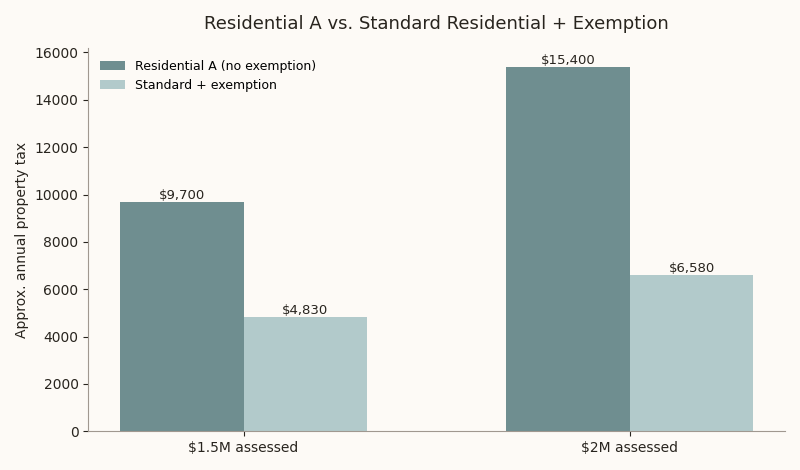
Here is the calculation worked out at two assessed values, so this is not an abstract warning. Oahu’s Residential A rate applies once a property is assessed at $1,000,000 or more with no home exemption on file: $4.00 per $1,000 on the first million of assessed value, and $11.40 per $1,000 on everything above that. Standard residential property with the owner-occupant exemption applied is taxed at $3.50 per $1,000, after subtracting the exemption amount from the assessed value.
| Assessed Value | Residential A (no exemption) | Standard Residential (with exemption) | Annual Difference |
|---|---|---|---|
| $1,500,000 | ≈$9,700/yr | ≈$4,830/yr | ≈$4,870/yr |
| $2,000,000 | ≈$15,400/yr | ≈$6,580/yr | ≈$8,820/yr |
What this tells me as the numbers agent for Oahu sellers: this is not a rounding error. On a $2 million inherited home, the gap between Residential A and a properly filed exemption runs close to $9,000 a year, which is exactly the kind of cost that should be resolved in the first weeks of administration, not discovered on a tax bill months later.
Insurance costs more once a home is vacant
A standard homeowner’s policy is written for an occupied home. Once a property sits vacant, many carriers require a vacant-home policy or endorsement, which typically costs more than standard coverage because an empty home carries more risk: undetected water leaks, break-ins, and slower response to any damage that does occur. Skipping this step to save money is the wrong place to cut, since a claim on a policy that has lapsed due to vacancy can be denied entirely.
Utilities, HOA fees, and basic upkeep
Even at minimal levels, keeping some power running for a dehumidifier and security system, along with basic landscaping to avoid an obviously vacant appearance, adds up monthly. If the property is a condo or townhome, association fees continue regardless of occupancy, and those are often the least negotiable cost on this entire list.
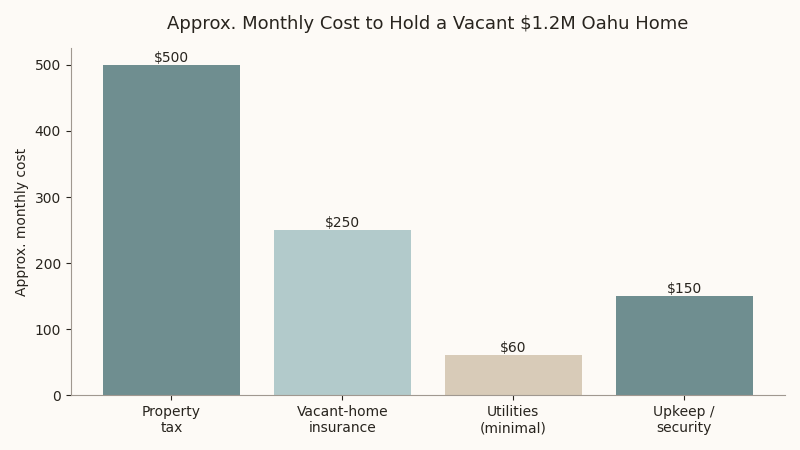
| Cost Category | Approx. Monthly Range (Illustrative) | Notes |
|---|---|---|
| Property tax | $400-$900+ | Depends on assessed value and whether the home exemption still applies |
| Vacant-home insurance | $150-$400 | Typically higher than an occupied-home policy |
| Utilities (minimal) | $40-$100 | Enough for a dehumidifier and basic security, not full occupancy |
| Upkeep, landscaping, HOA if applicable | $100-$300+ | HOA/AOAO fees continue regardless of occupancy |
What this tells me as the numbers agent for Oahu sellers: the monthly cost of indecision is real and ongoing, which is worth naming plainly, not to rush a decision, but so the timeline you choose is an informed one rather than an accidental one.
This is not a reason to rush
None of this is meant to push a decision before you and any co-heirs are ready. It is meant to make the real cost of time visible, since an accurate monthly number is genuinely useful information when you are weighing whether to sell now, rent it out, or hold it a while longer while the estate settles.
Frequently Asked Questions
Does the home automatically lose the parent’s exemption the moment they pass?
The exemption is tied to owner-occupancy. Once that changes, you generally have to notify the Real Property Assessment Division within 30 days, or by November 1 at the latest for that tax year. Missing that window can bring a $300-per-year penalty plus rollback taxes under Revised Ordinances of Honolulu Section 8-10.1(d), so this is worth handling early rather than assuming it will sort itself out.
Can the estate get a discount or exemption while probate is pending?
Rules vary and change, and this is worth confirming directly with RPAD rather than assuming a blanket rule applies. A CPA or probate attorney familiar with Hawaii property tax can also weigh in on your specific situation.
Is it worth paying for a house sitter or check-in service instead of leaving it fully empty?
For homes that will sit for several months or more, some heirs find a local check-in service worthwhile for the peace of mind and faster response to any issue, even though it adds a small monthly cost on top of everything else.
Does selling quickly always make more financial sense than holding the home longer?
Not necessarily. It depends on your specific tax situation, the local market, and what the estate needs from the sale. This monthly cost is one input into that decision, not the only one, which is exactly the kind of conversation worth having with someone who knows the numbers before you commit to a timeline.
If you want a clearer picture of what your specific property is costing you each month it sits, and what your realistic options are, book a free 20-minute strategy call here, or start with the full probate overview here.