

By Aksana Tupalskaya | August 23, 2026
Quick Answer
How does HARPTA affect an inherited Oahu property, and what’s the trap most heirs hit?
HARPTA withholds 7.25% of the amount realized at sale, and that withholding applies to the full sale price even when your actual taxable gain is small or zero because of the stepped-up basis you received as an heir. The trap is assuming a low-gain sale means no withholding automatically applies. It doesn’t. You have to proactively file Form N-288B, at least 10 working days before the transfer date, to reduce or eliminate withholding based on your real numbers.
What HARPTA actually withholds, and why it surprises heirs
Hawaii’s HARPTA law requires the buyer to withhold 7.25% of the amount realized on a real property sale by a nonresident seller, whether that seller is an individual owner or an estate administered outside Hawaii. The amount realized includes the sale price and any liability the buyer assumes, not just cash proceeds. [SOURCE: State of Hawaii Department of Taxation, Tax Facts 2010-1, “Understanding HARPTA,” revised April 2025]
Here’s where heirs get surprised: stepped-up basis means the property’s cost basis resets to its fair market value on the date of death, which usually shrinks your taxable gain dramatically compared to what the original owner would have owed. But HARPTA withholding is calculated on the sale price, not on your gain. Unless you take action, the buyer withholds 7.25% of the full amount realized regardless of how little you actually owe in tax.
The form that fixes this: N-288B
Form N-288B is a withholding certificate you file with the Hawaii Department of Taxation when you expect the tax due to be less than the standard withholding amount, exactly the situation most heirs with stepped-up basis are in. The Department’s own guidance is specific about timing: N-288B must be filed at least 10 working days before the transfer date, or it will not be approved in time to reduce withholding at closing. [SOURCE: Hawaii DoT, Tax Facts 2010-1]
Miss that window, and the full 7.25% gets withheld at closing regardless of your actual gain. You can still recover an overpayment afterward using Form N-288C to request a refund, but that means your money sits with the state for months instead of coming to you at closing.
| Scenario | Amount Withheld at Closing (7.25%) | Actual Taxable Gain |
|---|---|---|
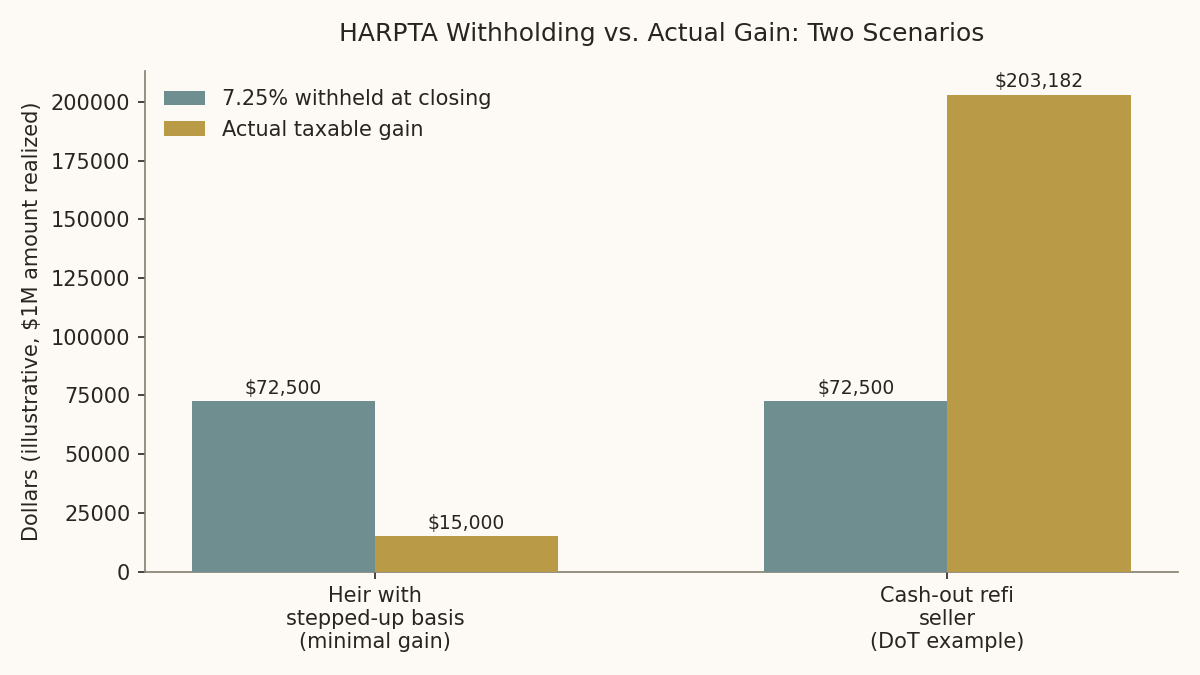
| Heir with stepped-up basis, minimal gain | $72,500 illustrative, on $1M amount realized | As little as $15,000 illustrative, depending on your basis |
| Cash-out refinance seller, Hawaii DoT’s own worked example | $72,500 illustrative, on $1M amount realized | $203,182, per the Department’s published example |
What this tells me as the numbers agent for Oahu sellers: the withholding percentage is identical in both cases, which is exactly why heirs can’t assume a small gain means small withholding. The two numbers move independently.
What to actually do, in order
If you’re selling an inherited Oahu property, the practical sequence is: get a qualified basis calculation early, ideally from a CPA who can document the property’s fair market value at the date of death, decide whether your expected gain is low enough to justify filing Form N-288B, and if so, file it at least 10 working days before your closing date, not the day before. Your escrow or title company can usually confirm the exact transfer date once you’re under contract, which is what starts that 10-working-day clock.
None of this is optional paperwork you can skip because the situation feels obviously low-gain. The Department requires the filing regardless of how confident you are in your own math.
Frequently Asked Questions
Does HARPTA apply to inherited property even though I’m getting a stepped-up basis?
Yes. Stepped-up basis usually reduces your taxable gain, sometimes close to zero, but HARPTA withholding is calculated on the amount realized at sale, not on your actual gain. You need to file for an exemption or reduction to avoid over-withholding.
What form do I file if my inherited home sale has little or no taxable gain?
Form N-288B, the withholding certificate, is the standard route when the tax owed is expected to be less than the standard withholding. It must be filed at least 10 working days before the transfer date, so timing matters.
Is a transfer by inheritance itself subject to HARPTA?
The transfer by bequest to you as the heir is a nonrecognition event Hawaii conforms to, but Form N-289 is still required to document that status. HARPTA becomes relevant again when you, the heir, later sell the property.
This is general information about a specific Hawaii tax withholding rule, not tax advice for your situation. A CPA or tax attorney should confirm your actual basis and gain before you rely on any number here. If you want to talk through timing the sale around this filing window, book a free 20-minute strategy call here, or get the free Mainland Owner and HARPTA guide here.



