

Quick Answer
How does HARPTA withholding work when you sell an Oahu home from the mainland?
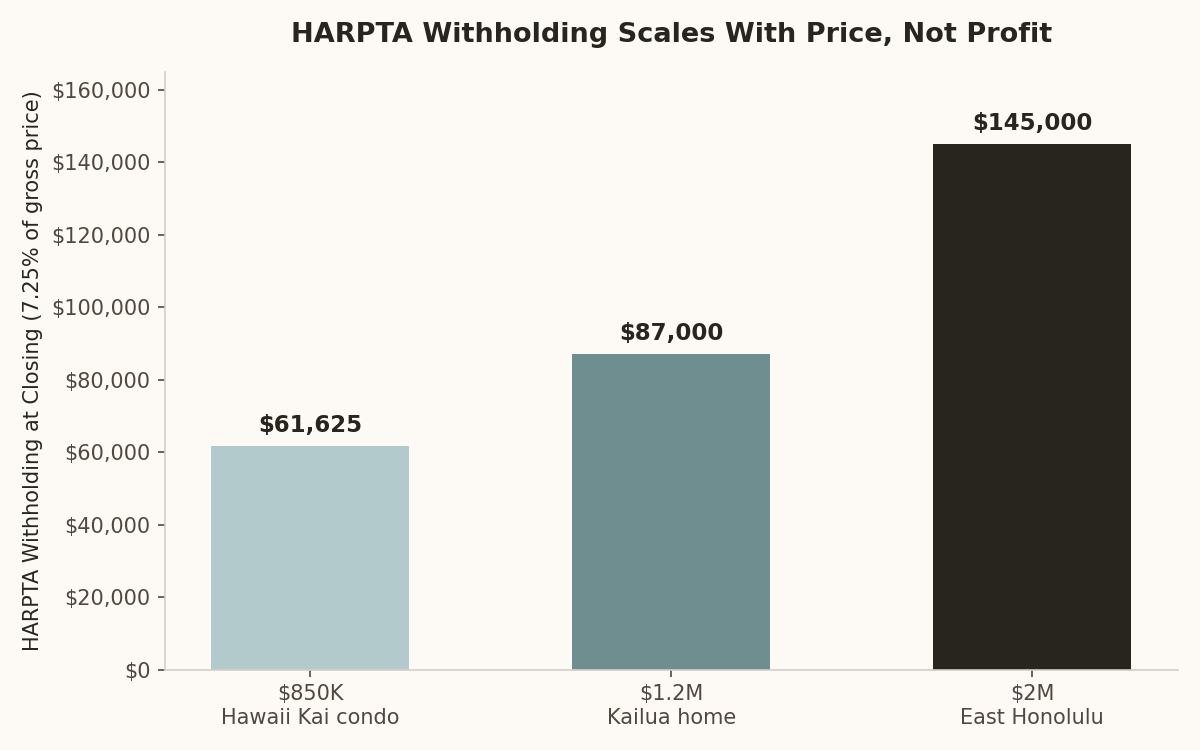
Hawaii requires the buyer to withhold 7.25% of the gross sale price at closing when the seller is not a Hawaii resident. On a $1.2 million Kailua sale, that is $87,000 held by the state before you see a dollar of your proceeds. It is a prepayment against your Hawaii tax, not the tax itself, and most out-of-state sellers get a significant share of it back. You can also reduce it before closing by filing Form N-288B, or recover the excess afterward with Form N-288C.
By Aksana Tupalskaya | August 8, 2026
| Sale Price | HARPTA Withholding (7.25% of gross) | Applies Regardless Of |
|---|---|---|
| $850,000 Hawaii Kai condo | $61,625 | Gain or loss on the sale |
| $1,200,000 Kailua home | $87,000 | Gain or loss on the sale |
| $2,000,000 East Honolulu property | $145,000 | Gain or loss on the sale |
What this tells me as the numbers agent for Oahu sellers: HARPTA withholding scales directly with your sale price, not your profit, so the higher the price point, the more of your own money sits with the state until you file to get it back.
If you own an Oahu property and live somewhere else, the biggest surprise in your sale is usually not the commission or the conveyance tax. It is the amount escrow keeps at closing.
Most mainland owners find out about it two weeks before closing, from their escrow officer, at the worst possible moment to be planning anything. It is worth understanding months earlier, because the most useful move has a deadline attached.
The number that catches people off guard
HARPTA is the Hawaii Real Property Tax Act. When the seller is not a Hawaii resident, it obligates the buyer to withhold 7.25% of the gross sales price and send it to the Hawaii Department of Taxation. In practice, escrow handles the mechanics.
Read that again: gross sales price, not profit. That distinction is where the sticker shock lives.
- A $1.2 million Kailua home: $87,000 withheld.
- An $850,000 Hawaii Kai condo: $61,625 withheld.
- A $2 million East Honolulu property: $145,000 withheld.
It applies whether or not you made money. Sell at a loss and the withholding still comes out, because it is calculated on price rather than gain. Sellers who bought near the top of a cycle and sold flat have watched a six-figure sum leave escrow on a transaction that produced no taxable profit at all.
Why the withholding is usually larger than what you actually owe
The withholding is a blunt instrument. Your real Hawaii tax is calculated on your gain, which means your purchase price, your capital improvements, your selling costs, and any depreciation you claimed while it was a rental all enter the math. HARPTA ignores every one of those and takes a flat percentage off the top.
Consider an owner who bought a Kailua home in 2015 for $700,000 and sells this year for $1.2 million. The withholding is $87,000. The actual Hawaii tax owed on that gain, after basis adjustments and the costs of the sale, is typically a good deal less. The difference is your money, sitting with the state, until you take a specific step to ask for it.
That is the part worth planning around. Nobody is stealing anything. But the default path means an interest-free loan to the State of Hawaii for as long as it takes you to file.
The three forms that decide how much of your money floats
Form N-289: certifying you are exempt
This is the form that establishes no withholding is required, most commonly because the seller is a Hawaii resident. If you genuinely qualify for an exemption, N-289 goes to the buyer and the withholding does not happen. If you live on the mainland and the property is not your Hawaii residence, you generally do not qualify, and no amount of paperwork changes that.
Form N-288B: reducing the withholding before closing
This is the one most out-of-state sellers should know about and most have never heard of. N-288B asks the state to approve a reduced withholding amount based on your actual expected tax. If it is approved before closing, escrow withholds the smaller figure and the rest never leaves your proceeds.
The catch is timing. It has to be filed and approved before the transaction closes. Start it the week before your closing date and you will miss it. This is the single most common preventable mistake I see with mainland sellers, and it is the reason I ask about residency in the very first conversation rather than during escrow.
Form N-288C: getting the excess back sooner
If the withholding already happened and it exceeded your real liability, N-288C requests an early refund rather than waiting to claim it on your annual Hawaii return. Processing times vary year to year, so ask your CPA what to expect for the current filing season instead of assuming last year answer.
What to line up before you list
- Your basis documents. The settlement statement from when you bought, plus receipts for capital improvements. A renovated lanai or a new roof raises your basis and lowers your gain.
- Depreciation records, if it was ever a rental. Depreciation recapture changes the calculation and surprises people who rented the place out for a few years.
- A CPA who has handled Hawaii nonresident sales. Not every mainland accountant has seen HARPTA. Ask directly.
- An honest conversation about timing. If the N-288B route makes sense for you, the filing has to start early enough to be approved before closing.
- Clarity on a 1031 exchange, if you are buying replacement property. The rules interact, and the decision has to be made before you close, not after.
Your escrow officer will handle the forms competently. What escrow will not do is tax planning, and it is not their job to. That gap is where mainland sellers lose the most money, and it closes with one conversation early enough to matter.
None of this is legal or tax advice, and your situation has details this article cannot know. Run your own numbers with a CPA who knows Hawaii. What I can tell you is what the withholding will look like on your specific price point, and when the clock starts.
Frequently asked questions
Is HARPTA a tax?
No. It is a withholding, which functions as a prepayment against whatever Hawaii tax you actually owe on the sale. The final bill is calculated on your gain when you file.
Does HARPTA apply if I sell at a loss?
Yes. The 7.25% is based on the gross sale price, not on profit, so it comes out even when the sale produces no taxable gain. Recovering it means filing.
I own the property with my spouse, who lives in Hawaii. Does that help?
It can change the calculation, because the treatment follows the ownership interests. Bring the exact vesting on your title to your CPA rather than assuming it is all or nothing.
What if I am not a US citizen?
Then FIRPTA, the federal equivalent, may apply on top of HARPTA at its own rate. The two stack, and the combined withholding is substantial enough that planning ahead stops being optional.
How long does it take to get the excess back?
It depends on the route you take and on state processing times that shift from year to year. Filing N-288C after closing is generally faster than waiting for your annual return, but ask your CPA what the current turnaround looks like.
Where this leaves you
HARPTA is not a reason to avoid selling your Oahu property from the mainland. It is a reason to start the conversation earlier than you otherwise would, because the most valuable option on the list expires at closing.
If you are an out-of-state owner thinking about selling this year, let us look at your actual price point, your basis, and your timeline together, and figure out whether the N-288B route is worth it in your case. Book a 20 minute strategy call here.



