By Aksana Tupalskaya | August 17, 2026
Quick Answer
What does “months of supply” actually mean for your Oahu home sale?
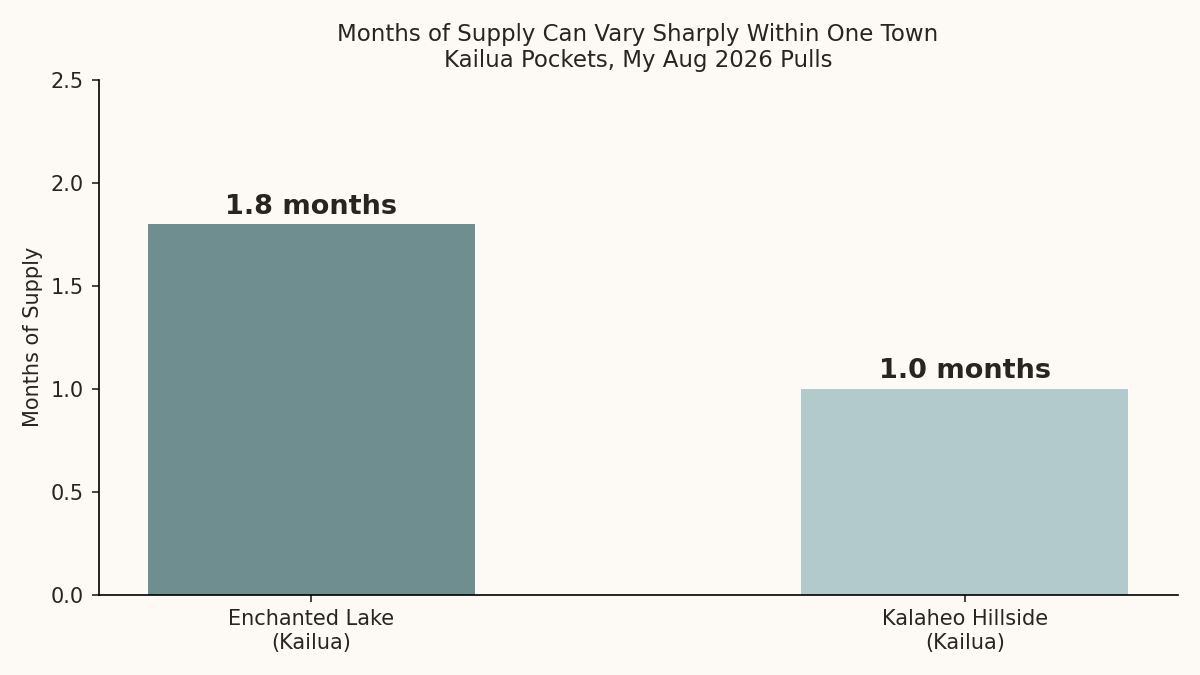
Months of supply estimates how long it would take to sell every home currently listed in an area at the current pace of sales, so a lower number means less competing inventory and generally more leverage for sellers. It can vary sharply within a single town: Kailua’s Enchanted Lake pocket is currently running about 1.8 months of supply while Kalaheo Hillside, also in Kailua, is closer to 1 month. A citywide or even town-wide average can hide exactly the pocket-level tightness or looseness that actually affects your specific sale.
What the Numbers Actually Show
| Market Indicator | Figure | Source / Timeframe |
|---|---|---|
| Enchanted Lake (Kailua) months of supply | About 1.8 months | My MLS pull, Aug 2026 |
| Kalaheo Hillside (Kailua) months of supply | About 1 month | My MLS pull, Aug 2026 |
| General rule of thumb | Under ~4-5 months typically favors sellers | Standard market-supply framework |
What this tells me as the numbers agent for Oahu sellers: price to your pocket’s number, not the town’s, because the town’s number is an average of two very different realities.
How months of supply actually gets calculated
The math is simpler than the term sounds: take the number of active listings in an area right now, divide by the average number of homes selling per month, and you get an estimate of how long the current inventory would last if nothing new came onto the market. A pocket with 10 active listings selling at a pace of 5 per month has about 2 months of supply. It’s a snapshot, not a forecast, and it moves as both sides of that equation change.
Real estate commentary tends to quote this number at the city or even state level, which is useful for a general sense of the market but nearly useless for pricing a specific home. Oahu is made up of dozens of distinct pockets, each with its own supply and demand balance, and two pockets five minutes apart can show meaningfully different numbers, exactly like Enchanted Lake and Kalaheo Hillside do right now.
Why the pocket-level number is what actually matters to you
If you’re selling in Enchanted Lake, roughly 1.8 months of supply means there’s very little competing inventory for a buyer to consider instead of your home, which generally supports a stronger negotiating position and a faster sale. Kalaheo Hillside, at roughly 1 month, is even tighter. Both numbers point toward a seller’s market in these specific pockets right now, even if a broader Kailua or island-wide figure looks different.
As a buyer, a low months-of-supply pocket tells you to expect more competition and less room to negotiate on price, while a higher number in another pocket might mean more selection and more leverage. Either way, the number that matters is the one for the specific streets you’re actually considering, not the headline for the town or the island.
This is exactly the kind of pocket-level pull I run before pricing any listing, because a seller pricing off a citywide average can leave money on the table in a tight pocket, or overprice in a looser one.
What to ask before you trust a supply number
Ask what geography the number covers and how current the pull is. A months-of-supply figure from three months ago in a fast-moving pocket can already be stale, and a number covering “Kailua” broadly can mask a pocket running twice as tight or twice as loose as the average.
Frequently Asked Questions
What counts as a “seller’s market” in terms of months of supply?
There’s no single universal cutoff, but supply under roughly 4-5 months is generally considered to favor sellers, with anything meaningfully lower, like the 1-2 month range seen in these Kailua pockets, indicating a tighter market still.
Why does my agent’s number look different from what I see online?
Online portals often calculate months of supply at a broad, sometimes outdated, geographic level. A pull scoped to your specific pocket and pulled recently from MLS data will usually tell a more accurate and more current story.
Can months of supply change quickly?
Yes, especially in small, thinly traded pockets like the ones referenced here, where just a few new listings or a few sales can swing the number meaningfully month to month.
Want to see what homes in your neighborhood actually sold for after credits? Get the free monthly Kailua & Hawaii Kai sold report here.