By Aksana Tupalskaya | August 17, 2026
Quick Answer
Should you buy new construction or a resale home on Oahu right now?
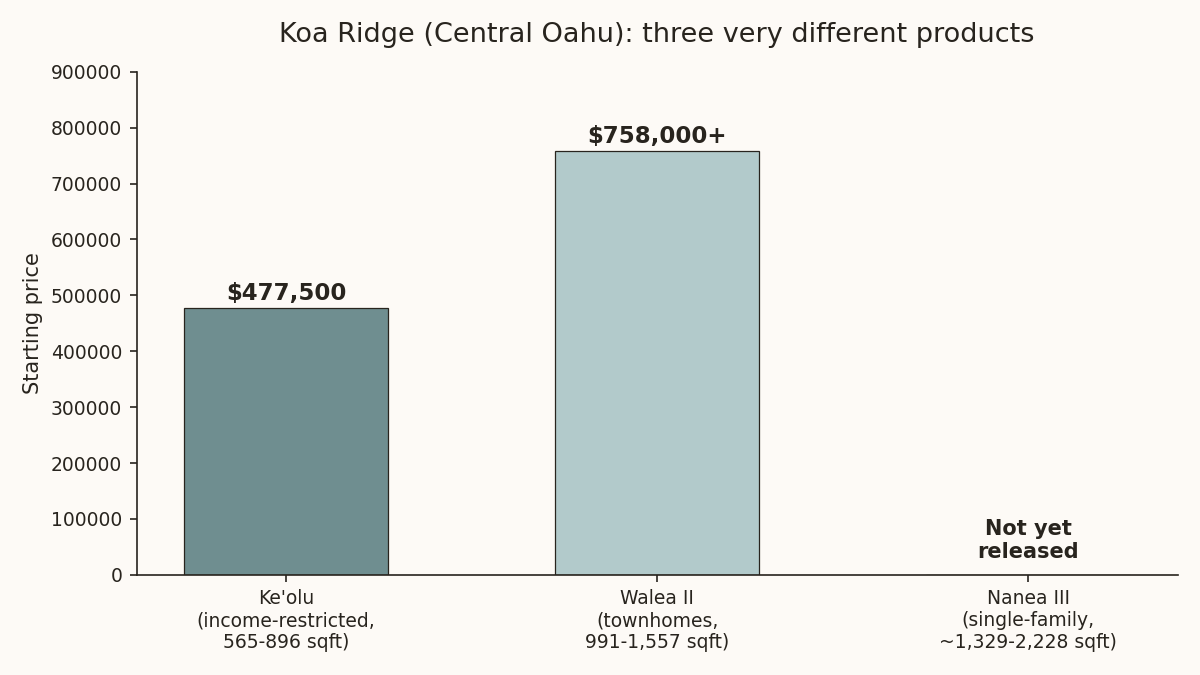
It depends far more on commute and product type than on a single price comparison. Ka’ulu by Gentry sits in Ewa on the west side, where rush-hour drives into Honolulu commonly run an hour and can stretch toward 90 minutes on a bad day. Koa Ridge, Castle & Cooke’s new community in Waipio, Central Oahu, is a meaningfully shorter drive, generally 30 to 40 minutes, but it isn’t one product either: income-restricted Ke’olu homes start at $477,500, market-rate Walea II townhomes start at $758,000, and Nanea III single-family homes haven’t been priced yet. Compare within the same commute zone and the same product type, not a blended number across all of it.
What the Numbers Actually Show
| Market Indicator | Figure | Source / Timeframe |
|---|---|---|
| Koa Ridge, Ke’olu (income-restricted townhomes, Central Oahu) | Starting $477,500, 565-896 sqft | Koa Ridge on-site tour notes, Aug 2026 |
| Koa Ridge, Walea II (market-rate townhomes, Central Oahu) | Starting $758,000, 991-1,557 sqft | Koa Ridge on-site tour notes, Aug 2026 |
| Koa Ridge, Nanea III (single-family, Central Oahu) | Price not yet released, approx. 1,329-2,228 sqft | Koa Ridge on-site tour notes, Aug 2026 (community opened 6/28/2026) |
| Rush-hour commute, Koa Ridge/Central Oahu to downtown Honolulu | Generally 30-40 minutes, longer at the H-1/H-2 merge during peak | General commute research, not an MLS figure |
| Rush-hour commute, Ewa to downtown Honolulu | Commonly 1 hour, up to about 90 minutes on a bad day | General commute research, not an MLS figure |
What this tells me as the numbers agent for Oahu buyers: Koa Ridge alone spans a $280,000+ starting-price range across three products before you even get to a single-family price, so “what does new construction cost in Central Oahu” only has an answer once you say which product you mean.
Why price per square foot isn’t the right tool here
In Hawaii, the land underneath a home usually carries most of its value, not the structure sitting on it. A per-square-foot number divides price by house size and hides the thing actually driving the price, which is the lot. Two homes of very different sizes on similar land can be worth similar amounts, and a lower per-square-foot figure in one area often just means the lots there are bigger, not that the real estate is cheaper. That’s true island-wide, and it’s especially true comparing a brand-new master-planned community like Koa Ridge, still releasing its pricing three weeks after opening, against an established west-side community like Ka’ulu.
The more honest comparison is commute plus absolute price plus what you actually get: bedrooms, square footage, lot situation, and whether the loan you’d be financing makes sense at today’s rates. That’s also why Koa Ridge itself resists being reduced to one number. Ke’olu is income-restricted affordable housing with a 10-year owner-occupancy requirement before resale, a genuinely different product and buyer pool than Walea II’s market-rate townhomes, which are a different product again than the Nanea III single-family homes, still unpriced as of this writing.
What each side actually gets you
New construction buyers get a builder warranty, current code compliance, and a home nobody has lived in. At Koa Ridge specifically, that includes EV-ready outlets, solar water heating, and split A/C on the Walea II townhomes, plus enclosed two-car garages and 9-foot ceilings on the Nanea III single-family plans. You’re also buying on the builder’s release schedule and into a planned community with its own CC&Rs or HOA.
Resale buyers get to see exactly what they’re getting, room by room, and often more flexibility on move-in timing and closing terms. Established landscaping, mature trees, and a settled neighborhood are real value even when they don’t show up as a line item. The trade-off is more unknowns: roof age, plumbing, electrical, and whether disclosed issues are the only issues.
Financing is worth checking on both sides. New construction sometimes comes with builder-incentive financing that resale can’t match, while a resale home might carry an assumable low-rate loan a buyer can take over instead of originating a new one at today’s rate. That’s exactly the kind of number I walk buyers through side by side before they commit to either path.
How to decide which fits your situation
Start with the commute, then narrow to product type, then compare absolute price and lot situation within that same commute zone. If you work near downtown Honolulu or Waikiki, a Koa Ridge or other Central Oahu option cuts real time off your day compared to Ewa, but you still need to know whether you’re shopping Ke’olu’s income-restricted pricing, Walea II’s townhomes, or a future Nanea III single-family release, since those aren’t interchangeable. If Ewa’s pricing and warranty coverage outweigh the longer commute for your household, that’s a legitimate call too.
Your specific number depends on your timeline, financing options, commute tolerance, income eligibility if Ke’olu is in play, and which neighborhoods you’re willing to consider. That’s exactly the kind of comparison I run for buyers before they write an offer on either side.
Frequently Asked Questions
Is new construction cheaper than resale on Oahu right now?
It depends entirely on the community and product type, not a single island-wide answer. Koa Ridge alone ranges from $477,500 for income-restricted townhomes to $758,000-plus for market-rate townhomes, with single-family pricing not yet released. Ask for the specific product and current pricing before assuming either side is cheaper.
Is Koa Ridge’s shorter commute worth it compared to Ewa communities like Ka’ulu?
For many buyers who work near downtown Honolulu, yes: Koa Ridge’s Central Oahu location generally runs a shorter rush-hour drive than Ewa’s, though the H-1/H-2 merge adds its own congestion during peak hours. It depends on your specific work location and how you value that time.
Can I qualify for Ke’olu’s income-restricted pricing at Koa Ridge?
Ke’olu requires buyers to qualify at or under 120% of area median income, be a first-time homebuyer or qualify for an exception, hold U.S. citizenship or permanent residency, establish Hawaii residency, and commit to owner-occupancy for 10 years before resale. Confirm current income limits and availability with the sales office directly.
Want to see what homes in your neighborhood actually sold for after credits? Get the free monthly Kailua & Hawaii Kai sold report here.