

Quick Answer
What is the Real Property Tax Credit for Homeowners, and why do so many Oahu owners miss it?
It’s a separate City and County of Honolulu program, distinct from the home exemption, that caps an eligible owner-occupant’s property tax bill at a set percentage of their household income. Like the home exemption, it’s filed with the Department of Budget and Fiscal Services by September 30 every single year — but unlike the exemption, you have to reapply annually even if nothing about your home has changed, and it’s easy to assume one filing covers both programs when it doesn’t.
By Aksana Tupalskaya | September 13, 2026
If you already know about Honolulu’s home exemption, the deduction that lowers your assessed value before tax is calculated, this is a different, separate program that most homeowners have never heard of. It’s income-based, it has its own annual deadline, and if you qualify and don’t file it every year, you’re leaving real money on the table. This is general education on a city program, not tax advice — always confirm your specific eligibility directly with the Tax Relief Office.
How the Credit Actually Works
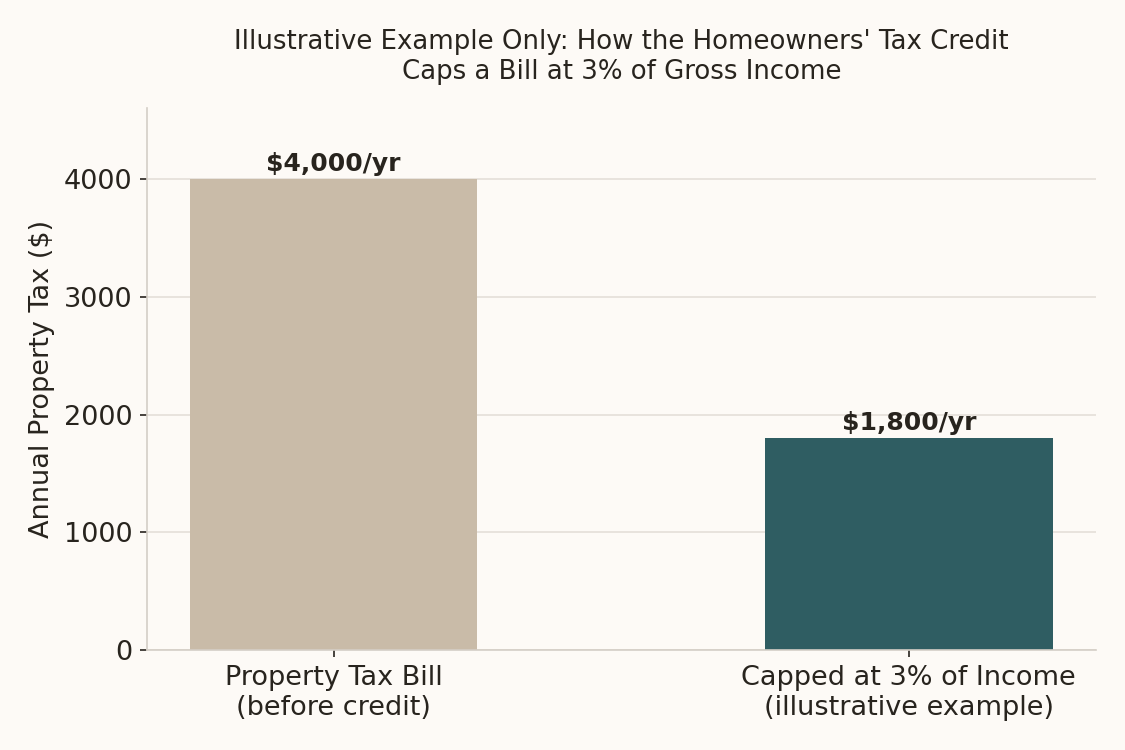
The Real Property Tax Credit for Homeowners, administered by the City and County of Honolulu’s Department of Budget and Fiscal Services, is built around one core idea: no eligible owner-occupant should have to pay property tax that eats up an outsized share of their household income. The credit is calculated as the difference between what your property tax bill would otherwise be and a set percentage of your combined household gross income. If your calculated tax exceeds that percentage of income, the credit covers the difference, and your bill is effectively capped.
This is a completely separate mechanism from the home exemption. The home exemption reduces the assessed value your tax is calculated against, in a flat dollar amount, regardless of your income. This credit works off your income directly, applied against your tax bill after the exemption has already been factored in. A homeowner can and often should be using both at once.
Who Actually Qualifies
The city’s published eligibility requirements have stayed consistent in structure year to year:
- The combined gross income of every titleholder on the property cannot exceed a set annual limit. That income limit is set by the city and has historically been reviewed annually — in the most recent confirmed filing cycle it stood at $80,000 combined, but income limits like this are subject to change, and this office has not independently reconfirmed that exact figure for the current filing cycle. Confirm the current year’s limit directly with the Tax Relief Office before assuming any number, including this one.
- None of the titleholders can own any other property, anywhere, not just on Oahu.
- You must have the home exemption filed and approved for both the current tax year and the upcoming tax year — this credit is layered on top of the exemption, not a substitute for it.
- You must reapply every single year. Unlike the home exemption, which stays in place automatically once filed unless ownership or use changes, this credit resets annually. A homeowner who received it last year and does nothing this year will not receive it again.
The Deadline That’s Easy to Miss
The filing deadline is September 30, the exact same date as the home exemption deadline. That overlap is precisely why this credit is so often missed: homeowners who filed their home exemption years ago, and haven’t had to think about it since, assume every property tax filing works the same way. This one doesn’t. It has to be actively renewed every year, on the same September 30 clock, with its own separate application.
This is exactly the kind of program that a fixed-income homeowner, or the adult child helping a parent manage their paperwork, should be checking every single year rather than assuming “we already took care of that.”
How the Cap Actually Reduces a Bill
To be clear about mechanics without inventing a number for your specific situation: the program calculates what percentage of your household’s gross income your current property tax bill represents. If your tax bill, after the home exemption, still exceeds the program’s set income percentage, the credit covers everything above that percentage. For a homeowner on a fixed or modest income whose property value (and therefore assessed value) has climbed over the years, this credit can be the difference between an affordable bill and one that puts real pressure on a household budget.
Real Property Tax Credit at a Glance
| Requirement | Detail |
|---|---|
| Filing deadline | September 30, every year, no exceptions |
| Reapplication | Required annually — does not carry over automatically like the home exemption |
| Combined household income limit | Set annually by the city — confirm the CURRENT figure with the Tax Relief Office before relying on any number |
| Other-property rule | No titleholder may own property anywhere else |
| Home exemption requirement | Must be filed and approved for both the current and upcoming tax year |
| Where to confirm / apply | Tax Relief Office, (808) 768-3205, [email protected] |
What this tells me as the numbers agent for Oahu owners: this is one of the only property tax programs that has to be actively renewed every year with no reminder built in, which means the homeowners who benefit most from it — those on a fixed or modest income — are also the ones most likely to lose it simply by not refiling.
Frequently Asked Questions
Is the Real Property Tax Credit the same thing as the home exemption?
No. The home exemption is a flat deduction from your assessed value, filed once and generally kept unless ownership or use changes. This credit is a separate, income-based program that caps your tax bill at a set percentage of household income, and it must be refiled every single year.
What is the current household income limit for this credit?
The city sets this limit annually, and it is subject to change from year to year. Rather than rely on a prior cycle’s figure, confirm the current limit directly with the Tax Relief Office at (808) 768-3205 or [email protected] before assuming you do or don’t qualify.
Do I need to reapply if I received this credit last year?
Yes. Unlike the home exemption, this credit is not automatically renewed. Every eligible homeowner must submit a new application by September 30 to keep receiving it.
Can I still qualify if I own a second property somewhere else?
No. None of the titleholders on the property can own any other property, anywhere, not just within Hawaii.
Who should I contact with questions about my specific situation?
The City and County of Honolulu’s Tax Relief Office handles this program directly: (808) 768-3205 or [email protected]. They can confirm current eligibility figures and walk you through the application.
Where This Leaves You
If you or a parent are on a fixed or modest income and haven’t checked on this credit recently, or ever, it’s worth a phone call before September 30. It costs nothing to ask, and the Tax Relief Office can confirm in a few minutes whether you qualify.
This is separate from, but related to, the home exemption filing that’s also due September 30 — if you’re not sure whether your home exemption itself is on file, that’s worth checking too. And if you’re weighing a sale and want to understand how your full property tax picture factors into your decision, book a strategy call.



