Quick Answer
How long does it take to sell a home in Hawaii Kai in 2026?
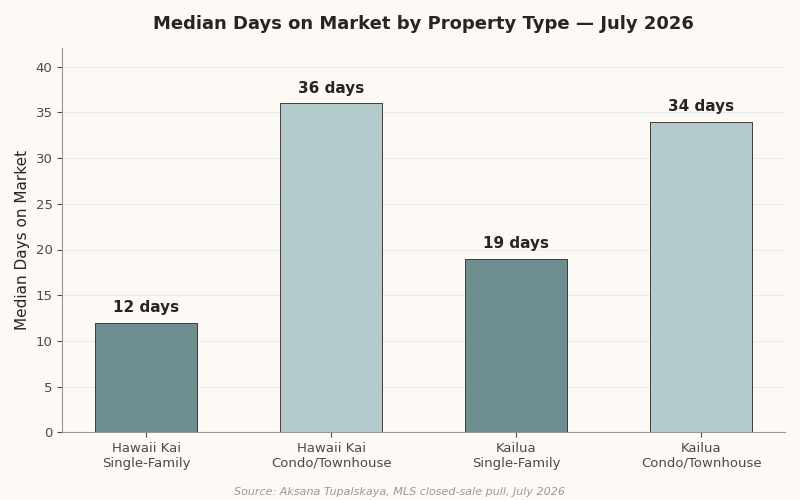
In July 2026, Hawaii Kai single-family homes sold in a median of 12 days at 99.2% of list price, while Kailua single-family homes took a median of 19 days at 98.6% of list, according to my MLS closed-sale pull. Hawaii Kai moves faster right now, but that speed doesn’t mean it’s the stronger market on price: over the past year, Hawaii Kai’s price per square foot is up only a couple percent while Kailua’s is up almost seven. Faster and cheaper is a different trade than slower and appreciating, and which one fits you depends on whether you’re buying or selling.
By Aksana Tupalskaya | August 9, 2026
| Market Indicator | Figure | Source / Timeframe |
|---|---|---|
| Hawaii Kai single-family, median days on market | 12 days | My MLS closed-sale pull, July 2026 |
| Hawaii Kai single-family, list-to-sale ratio | 99.2% | My MLS closed-sale pull, July 2026 |
| Hawaii Kai condo/townhouse, median days on market | 36 days | My MLS closed-sale pull, July 2026 |
| Kailua single-family, median days on market | 19 days | My MLS closed-sale pull, July 2026 |
| Kailua single-family, list-to-sale ratio | 98.6% | My MLS closed-sale pull, July 2026 |
| Kailua condo/townhouse, median days on market | 34 days | My MLS closed-sale pull, July 2026 |
What this tells me as the numbers agent for Oahu sellers: speed and price direction are two different stories right now, and which segment you’re in, single-family or condo, matters more than which of these two neighborhoods you’re comparing.
I get this question constantly from Hawaii Kai owners, especially the ones comparing their timeline to whatever they’re hearing about Kailua. The two markets are genuinely behaving differently right now, and the gap shows up in the actual closed-sale numbers, not just a feeling.
What actually closed in July
From my July 2026 sold report, straight from HiCentral MLS:
- Hawaii Kai single-family (12 sold): median $1,637,500, averaging 99.2% of list price, median 12 days on market.
- Hawaii Kai condo/townhouse (11 sold): median $750,000, averaging 97.5% of list, median 36 days on market.
- Kailua single-family (31 sold): median $1,799,000, averaging 98.6% of list price, median 19 days on market.
- Kailua condo/townhouse (12 sold): median $732,500, averaging 96.8% of list, median 34 days on market.
Two things stand out. First, in both neighborhoods, single-family homes are moving noticeably faster than condos: Hawaii Kai’s single-family homes sold in about a third of the time its condos did (12 days versus 36), and Kailua’s gap runs a similar direction (19 days versus 34). Second, Hawaii Kai’s single-family segment is actually outpacing Kailua’s on speed this month, 12 days versus 19.
Why Hawaii Kai moves faster but Kailua keeps climbing on price
Speed and price direction are telling two different stories right now. From my most recent MLS pull, looking at trends rather than a single month:
- Price per square foot, past 12 months: Hawaii Kai is up only a couple percent. Kailua is up almost seven percent.
- Median price: Hawaii Kai is down across the 3, 6, and 12-month windows. Kailua is up in every one of those same windows.
- Days on market: Hawaii Kai homes have been moving a few days faster than Kailua across every window measured.
- Months of supply: both markets loosened slightly over the past year. Hawaii Kai is up about 10% to roughly three and a third months. Kailua is up a little over 3% to just above three months. For comparison, supply across the entire Oahu MLS actually tightened close to 8% over the same period, so both of these markets are moving the opposite direction from the island as a whole.
- Pending sales, most recent month: Hawaii Kai jumped over 44%. Kailua climbed better than 17%. Both are outpacing the broader MLS.
- List-to-sale ratio, past year: Hawaii Kai sellers have closed at just over 98% of list price. Kailua sellers, just over 99%.
Put together: Hawaii Kai is a market where homes move quickly and buyers have a bit more room to choose from, but prices haven’t gained much ground. Kailua is slower, but the price keeps climbing regardless. Neither is the wrong market. They reward different strategies.
A real example: the Koko Head Terrace flip pattern
I recently toured a Hawaii Kai home in Koko Head Terrace that makes this concrete. An investor bought the house for $980,000 less than a year ago and just relisted it, fully renovated, for $570,000 more. I pulled every sale in that same pocket over the past year and found four other addresses that did the same thing: bought, renovated, and resold for gains ranging from $355,000 to nearly $493,000.
But that pattern isn’t automatic, and this is the part worth knowing before you assume your own home will do the same. Ten homes in that same pocket, roughly a quarter of everything that came to market there, cancelled or expired over the past year without selling. One sat 256 days before cancelling. Another expired after 221 days. One address cancelled twice, dropping its ask from $1.59 million to $1.695 million before finally going under contract at $1.49 million, below either earlier price. Even new construction wasn’t immune: one newly built home in the pocket cancelled twice near $2 million before it found a buyer.
The difference tended to come down to pricing for condition. Homes still asking original-condition prices for what should have been renovated-level numbers were the ones that sat. I walk through the full numbers on this specific home, and the pattern across the pocket, in the video: Sold for $980K, Back on the Market $570K Higher: Hawaii Kai Home Tour.
What this means if you’re planning to sell
- Single-family owners in either neighborhood: the market is closer to balanced, and realistic pricing from day one tends to produce a faster, cleaner sale.
- Condo owners in either neighborhood: expect more time on market and more room for buyer negotiation. Pricing even slightly aggressive can add weeks or months, and this shows up clearly in both markets’ July numbers.
- Hawaii Kai sellers specifically: speed is on your side right now, but don’t expect the price appreciation Kailua sellers are seeing. Price against what’s actually closed in your pocket, not the flip story next door.
- Kailua sellers specifically: the market is slower, but it’s rewarding patience with real price gains. A longer runway doesn’t mean something is wrong.
This is exactly the kind of question I walk clients through before we ever set a list price: what segment are you actually in, and what has genuinely closed in that segment recently, not what’s sitting active and unsold nearby.
Frequently Asked Questions
Are Hawaii Kai homes selling faster than Kailua right now?
Yes, for single-family homes. In July 2026, Hawaii Kai single-family homes sold in a median of 12 days versus 19 days in Kailua, and Hawaii Kai has moved a few days faster than Kailua across every recent time window.
If Hawaii Kai sells faster, why is Kailua considered the stronger market?
Speed and price appreciation are different measures. Hawaii Kai’s price per square foot is up only a couple percent over the past year, while Kailua’s is up almost seven percent, even though Hawaii Kai homes are moving faster.
Should I price my condo differently than a single-family home nearby?
Yes, in both neighborhoods. In July, Hawaii Kai condos took a median 36 days to sell versus 12 for single-family homes, and Kailua condos took 34 days versus 19 for single-family. Price and set expectations against actual recent sales in your specific property type.
Is the Koko Head Terrace renovate-and-resell pattern guaranteed to work?
No. While several homes in that pocket resold for significant gains after renovation, about a quarter of everything listed there in the past year cancelled or expired without selling, mostly homes still priced as if they hadn’t been updated.
How do I find out what’s actually closed recently in my building or street?
MLS data on active listings only tells part of the story. My monthly sold report shows closed prices, days on market, and any seller credits for both Kailua and Hawaii Kai.
What this means for your Hawaii Kai listing
Hawaii Kai and Kailua are moving at different speeds and in different price directions right now, and knowing which pattern applies to your specific property and segment changes how you should price and how patient you need to be. Want to see what homes near you actually sold for, including the seller credits Zillow can’t see? Get the free monthly Kailua & Hawaii Kai sold report at islandlivingoahu.com/credits.