

Quick Answer
Can you use a 1031 exchange on a house you inherited on Oahu, and does that get you out of HARPTA withholding?
Yes to both, with conditions. A 1031 exchange is one of the specific nonrecognition provisions Hawaii’s HARPTA rules recognize, so if you exchange into replacement property instead of taking cash, you can file Form N-289 to claim the exemption and avoid the 7.25 percent withholding on the sale. The exemption only covers the portion of the transaction that is a genuine like-kind exchange. Any cash or other value you actually receive, called boot, is still subject to withholding.
By Aksana Tupalskaya | October 25, 2026
Yes, Inherited Property Can Qualify for a 1031 Exchange
There is nothing about inheriting a property that disqualifies it from a 1031 exchange. The exchange rules care about how the property is held and used, not how you came to own it. What does matter is that the property has to be held for investment or business use, not as your personal residence, both before and after the exchange.
This is the part heirs most often overlook. If you inherited an Oahu house and have been living in it yourself, it generally does not qualify for a 1031 exchange as it sits, since it is being held for personal use rather than investment. Heirs who want to preserve the option to exchange sometimes convert the property to a rental for a period before selling, specifically to establish the investment-use history the exchange requires. The right amount of time to do that is a question for your own tax advisor, not a fixed number this post should guess at.
How N-289 Actually Works for a 1031 on Inherited Property
Form N-289 is the certificate that tells the buyer and escrow not to withhold, because a recognized exemption applies to the sale. A 1031 exchange is explicitly one of the nonrecognition provisions Hawaii conforms to for this purpose, alongside transfers by gift, transfers by bequest, and transfers incident to divorce. Filing N-289 requires describing the transfer and summarizing the law and facts that support the exemption, which in practice means your qualified intermediary and tax advisor are involved in preparing it, not just your escrow officer. I cover the HARPTA basics that apply to every inherited Oahu sale, exchange or not, in HARPTA on inherited Oahu property, including a separate wrinkle about whether the estate itself counts as a resident or nonresident person, which affects withholding independently of the 1031 question.
One detail worth sitting with: N-289 has to be filed before closing, as part of the transaction, not afterward as a request for a refund. If the sale closes without it, the buyer is required to withhold the full 7.25 percent regardless of whether an exchange was intended, and getting that money back becomes a separate refund process through Form N-288C rather than something fixed retroactively at closing.
The Part That Still Gets Withheld: Boot
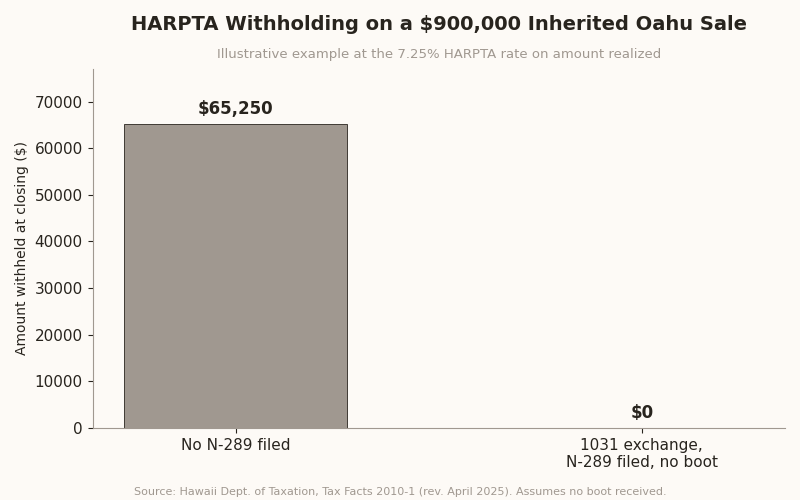
The exemption only covers the genuinely like-kind portion of the transaction. Anything you actually receive in cash, or any debt relief that functions like cash, called boot in exchange terminology, falls outside the exemption and gets withheld at the normal 7.25 percent rate. On a $900,000 inherited Oahu sale that is fully exchanged into replacement property with no boot, HARPTA withholding at closing is $0. If instead $100,000 of that $900,000 is taken out in cash rather than reinvested, withholding applies only to that $100,000 boot amount, which comes to $7,250, not the full $65,250 that would apply to a straight sale with no exchange and no exemption at all.
Why Many Heirs Don’t Actually Need This
Here is the part that surprises people: because inherited property generally gets a stepped-up basis to its value on the date of death, the taxable gain on a sale that happens reasonably soon after inheriting is often small, sometimes close to zero, even on a property worth a great deal. I walk through exactly how that date-of-death value gets established, and how it affects what you owe when you sell, in why the date-of-death value matters. When there is little real gain to defer in the first place, taking on a qualified intermediary, the 45 and 180 day clock, and the added complexity of an exchange may not be worth it. A 1031 exchange on inherited property tends to make the most sense when the estate genuinely wants to keep investing in real estate rather than taking cash, not as a reflexive tax move.
| Scenario | HARPTA Withholding at Closing | What’s Required |
|---|---|---|
| Straight sale, no exchange, no exemption | 7.25% of the full amount realized | Nothing extra beyond the standard sale paperwork |
| 1031 exchange, no boot received, N-289 filed | $0 | Form N-289 filed before closing, naming the 1031 nonrecognition provision and describing the exchange |
| 1031 exchange with some boot received | 7.25% on just the boot portion | Form N-289 filed, with the boot amount identified and reported |
What this tells me working with heirs considering an exchange: the exemption is real, but it only ever covers the part of the deal that is a genuine exchange, so a clean, no-boot structure is what actually gets you to zero withholding.
Frequently Asked Questions
Does the property have to be a rental for a 1031 exchange to qualify?
It has to be held for investment or business use rather than as your personal residence. If you inherited a house and have been living in it yourself, it generally does not qualify as it sits. Some heirs convert the property to a rental for a period first, specifically to establish that investment-use history, and your tax advisor can confirm what that timing should look like for your situation.
Do I still need to file N-289 if there is little real gain thanks to stepped-up basis?
Yes. N-289 is specifically what stops withholding at the closing table. Without it, withholding applies to the full amount realized at closing regardless of your actual gain, and you would only recover the difference afterward by filing for a refund.
Does the estate’s residency, or my own, matter separately from the 1031 question?
Yes, and this is a separate wrinkle covered in the main post on HARPTA and inherited property: whether the estate itself counts as a resident or nonresident person under HARPTA is a distinct question from whether a 1031 exchange applies, and both can affect withholding independently.
What if some heirs want to exchange and others just want cash?
Generally, only the portion of proceeds going to heirs who are actually completing an exchange qualifies for the N-289 exemption. This usually means structuring the sale so each heir’s share is treated according to what that specific heir is doing with it, which is a conversation for your CPA and attorney together, not something to assume works the same way for everyone involved.
Working Through This With the Right People
None of this is a decision to make alone from a blog post, including this one. Whether a 1031 exchange is worth pursuing on an inherited Oahu property depends on the actual numbers involved, how many heirs are sharing the proceeds, and what each of you actually wants to do next. A CPA who has handled Hawaii HARPTA transactions and, where an exchange is on the table, a qualified intermediary, are the right people to confirm the specifics with before you list.
If you are working through what to do with an inherited Oahu property and want to talk through the options without any pressure attached, I am glad to help. Book a free 20-minute strategy call: islandlivingoahu.com/strategy.



