
Quick Answer
Does your 1031 exchange replacement property have to be located in Hawaii?
No. Under federal 1031 exchange rules, like-kind real property located anywhere in the United States qualifies, with no requirement that the replacement property sit in the same state as the property you sold. For an out-of-state owner selling Oahu real estate, that means you can exchange out of Hawaii into a property closer to home. The part that trips people up isn’t the IRS rule, it’s how Hawaii’s separate nonresident withholding requirement, HARPTA, interacts with the exchange at closing.
By Aksana Tupalskaya | September 13, 2026
This post answers one specific mechanical question that comes up constantly with out-of-state Oahu sellers: can you 1031 exchange out of Hawaii entirely, or does the replacement property have to stay in the islands? It’s a different question from whether a 1031 exchange is the right move for you in the first place — see the related post below for that broader decision. This is general education, not tax or legal advice. A qualified intermediary and a CPA or attorney experienced in 1031 exchanges should confirm every detail of your specific transaction before you act on anything here.
The Federal Rule: Location Doesn’t Matter, Like-Kind Does
Section 1031 of the federal tax code allows an investor to defer capital gains tax on the sale of real property held for investment or business use by exchanging it for other “like-kind” real property. The IRS’s own guidance on like-kind exchanges is broad on what counts as like-kind for real estate: essentially any real property held for investment or business purposes qualifies as like-kind to any other such real property, regardless of grade or quality, and regardless of where in the United States either property is located.
In plain terms, that means an investor selling a rental property on Oahu can exchange into an apartment building in Texas, a commercial property in Colorado, or a duplex two blocks from where they actually live on the mainland, and it can still qualify as a valid 1031 exchange under federal law. There is no requirement anywhere in Section 1031 that the replacement property be located in the same state, or even reasonably near, the property that was sold. The core federal requirements are about timing (identifying a replacement property within 45 days, closing within 180 days) and structure (using a qualified intermediary, never touching the proceeds yourself), not geography.
Where Hawaii’s HARPTA Rule Enters the Picture
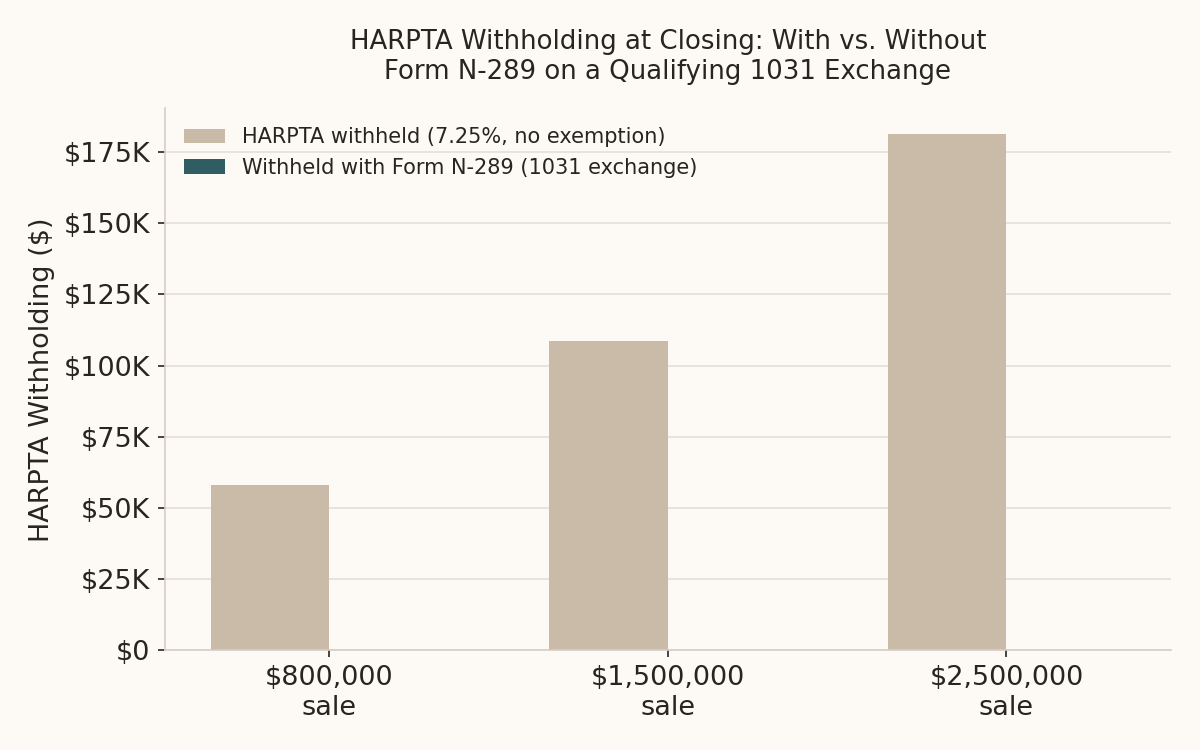
Here’s where the Oahu-specific piece comes in. Hawaii requires buyers to withhold 7.25 percent of the “amount realized” on any sale by a nonresident seller, under the Hawaii Real Property Tax Act, commonly called HARPTA. This withholding applies at closing regardless of whether you’re exchanging or selling outright, unless you take a specific step to address it.
That step is Form N-289. A seller who qualifies for a nonrecognition provision under the tax code, including a 1031 exchange, can give the buyer a completed Form N-289 at closing, and the buyer is then relieved of the obligation to withhold. Without it, the 7.25 percent withholding happens automatically, even though you’re exchanging into another property and not actually recognizing a taxable gain at that moment. According to the Hawaii Department of Taxation’s own published guidance, a 1031 exchange is explicitly one of the nonrecognition provisions Hawaii conforms to for this purpose, alongside transfers by gift, transfers by bequest, and transfers incident to divorce.
The Hawaii Department of Taxation’s guidance is also explicit on the exact question this post is answering: the seller does not need to replace the property with another property in Hawaii to use the 1031 nonrecognition exemption on Form N-289. The exchange itself is what matters for HARPTA purposes, not where the replacement property sits.
Where This Can Still Go Wrong
There’s a real limit here, and it’s the detail that catches people off guard. If any gain is actually recognized in the exchange, commonly called “boot,” meaning you receive cash, take on less debt than before, or receive any non-like-kind property as part of the deal, Form N-289 can no longer be used for that recognized portion. HARPTA withholding then applies to whatever gain was recognized, even inside an otherwise valid exchange. This is exactly why a qualified intermediary and a CPA who has actually run Hawaii-based 1031 exchanges before need to structure your specific transaction, not a generic online explainer.
It’s also worth restating plainly: Aksana is not a CPA, a 1031 qualified intermediary, or a tax attorney, and cannot act as your qualified intermediary. Federal rules require a QI to be someone with no other relationship to you as the taxpayer, including your real estate agent, within the two years surrounding the transaction. Any agent who offers to “handle the exchange” for you directly should raise a flag, not confidence.
1031 Exchange Location Question, at a Glance
| Question | Answer |
|---|---|
| Must the replacement property be in Hawaii? | No — federal 1031 rules allow like-kind real property anywhere in the U.S. (IRS) |
| Does exchanging out of Hawaii avoid HARPTA withholding? | Yes, if you give the buyer Form N-289 for the 1031 nonrecognition provision (Hawaii Dept. of Taxation) |
| HARPTA withholding without N-289, standard rate | 7.25% of the amount realized (Hawaii Dept. of Taxation) |
| What breaks the N-289 exemption | Any recognized gain / “boot” in the exchange — withholding then applies to that portion |
| Can your real estate agent serve as your qualified intermediary? | No — federal rules disqualify your agent from that role (IRS QI rules) |
What this tells me as the numbers agent for out-of-state Oahu sellers: the geography question almost never trips people up on the IRS side, it’s the Hawaii-specific HARPTA paperwork most sellers have never heard of, Form N-289, that decides whether you get to keep the full 7.25% at closing instead of waiting months for a refund.
Frequently Asked Questions
Do I have to buy another property in Hawaii to complete my 1031 exchange?
No. Federal 1031 rules only require the replacement property to be like-kind real property held for investment or business use, located anywhere in the United States. The Hawaii Department of Taxation’s own guidance confirms this applies to the HARPTA exemption as well.
What form keeps HARPTA from being withheld on my 1031 exchange?
Form N-289, given to the buyer at closing, claiming the 1031 nonrecognition provision. Without it, the standard 7.25% HARPTA withholding applies automatically to a nonresident seller’s transaction.
Can I use my real estate agent as my qualified intermediary?
No. The IRS specifically disqualifies anyone who has acted as your agent, attorney, accountant, or broker within the two years surrounding the transaction from serving as your qualified intermediary.
What happens if I receive some cash out of the exchange?
Receiving cash, taking on less debt, or receiving non-like-kind property as part of the deal is called “boot,” and it creates recognized gain. Form N-289 cannot shield that portion from HARPTA withholding, even if the rest of the exchange qualifies.
Should I talk to a CPA before deciding on a 1031 exchange?
Yes, always. This post explains the mechanics at a general level; your specific numbers, timeline, and structure need a qualified intermediary and a CPA or tax attorney experienced with Hawaii transactions before you commit to anything.
Where This Leaves You
If you’re an out-of-state owner selling Oahu property and considering a 1031 exchange, the location of your replacement property is very likely the least complicated part of the decision. The details that actually determine your outcome, timing, structure, and the HARPTA paperwork, need a qualified intermediary and a tax professional working from your specific numbers.
If you haven’t already weighed whether a 1031 exchange makes sense for your situation in the first place, read 1031 Exchange or Sell Outright: What Out-of-State Oahu Owners Should Weigh. And if you want to talk through your specific property and timeline, book a free 20-minute remote strategy call.



