
Quick Answer
How much house can you afford in Honolulu on your BAH?
There’s no single number, because Basic Allowance for Housing rates in Honolulu vary by rank and dependency status and are updated every year by the Department of Defense. Rather than guessing at a figure that may already be out of date, look up your exact current rate at the Defense Travel Management Office’s official BAH calculator, then work backward from that number using your loan type, rate, and whether you’re financing new or assuming an existing low-rate mortgage — because the gap between those two paths can be worth over a thousand dollars a month on the exact same loan amount.
By Aksana Tupalskaya | September 13, 2026
Honolulu’s BAH rates run well above the national average, reflecting the local cost of housing, and they change every year. Rather than publish a rate table here that’s likely to be stale within months, this guide focuses on the framework: how to find your real number, how to think about what portion of it should go toward a mortgage payment, and the one financing decision that moves the needle more than almost anything else for a military buyer on Oahu.
Start With Your Actual Rate, Not an Estimate
The only source that should ever inform your BAH figure is the Defense Travel Management Office (DTMO), the official Department of Defense authority on housing allowances. Their BAH Rate Lookup tool calculates your specific rate based on your duty station, pay grade, and dependency status, and it’s updated annually — DTMO’s own guidance notes that rates typically move with local rental costs, generally in the range of 2 to 5 percent a year. A number pulled from a blog post, a forum, or last year’s orders is not a substitute for checking your current rate directly.
One protection worth knowing about before you start house hunting: individual rate protection. If you’re already at your duty station and BAH rates drop the following year, you keep your prior, higher rate as long as your dependency status and pay grade don’t change and you don’t PCS. That protection only kicks in once you’re assigned, so it’s not something you can count on before you arrive, but it does mean a rate you’ve already locked in won’t get pulled out from under you while your lease or mortgage is in place.
BAH Covers Housing Costs — It Isn’t a Blank Check for a Mortgage Payment
DTMO is explicit that BAH is not designed to cover 100 percent of every service member’s housing costs in every case, and it’s meant to give members freedom in how they allocate that money, including choosing to spend less on housing to free up income elsewhere. That’s an important mental adjustment for a first-time buyer: BAH is a housing allowance, not a mortgage pre-approval number. A lender will look at your total income, debt, and the specific loan program’s underwriting rules, not just your BAH rate, to determine what you actually qualify to borrow.
A conservative starting framework many military buyers use: treat your BAH as covering principal, interest, taxes, and insurance (PITI), and build in room for Hawaii’s higher property tax and insurance costs relative to the mainland before assuming your full BAH translates directly into loan capacity. Your lender’s own VA loan calculation, using your full BAH and base pay, will give you the real number for your specific rate and family situation.
The Financing Decision That Matters More Than Almost Anything Else
For military buyers specifically, there’s one decision that can matter more than the size of your BAH: whether you’re financing new, at whatever today’s rate happens to be, or assuming an existing seller’s loan at a rate locked in years ago. On identical loan amounts, the difference in monthly payment between an assumed low rate and a new-rate loan can be enormous — and unlike your BAH rate, this is a number you have real control over as a buyer.
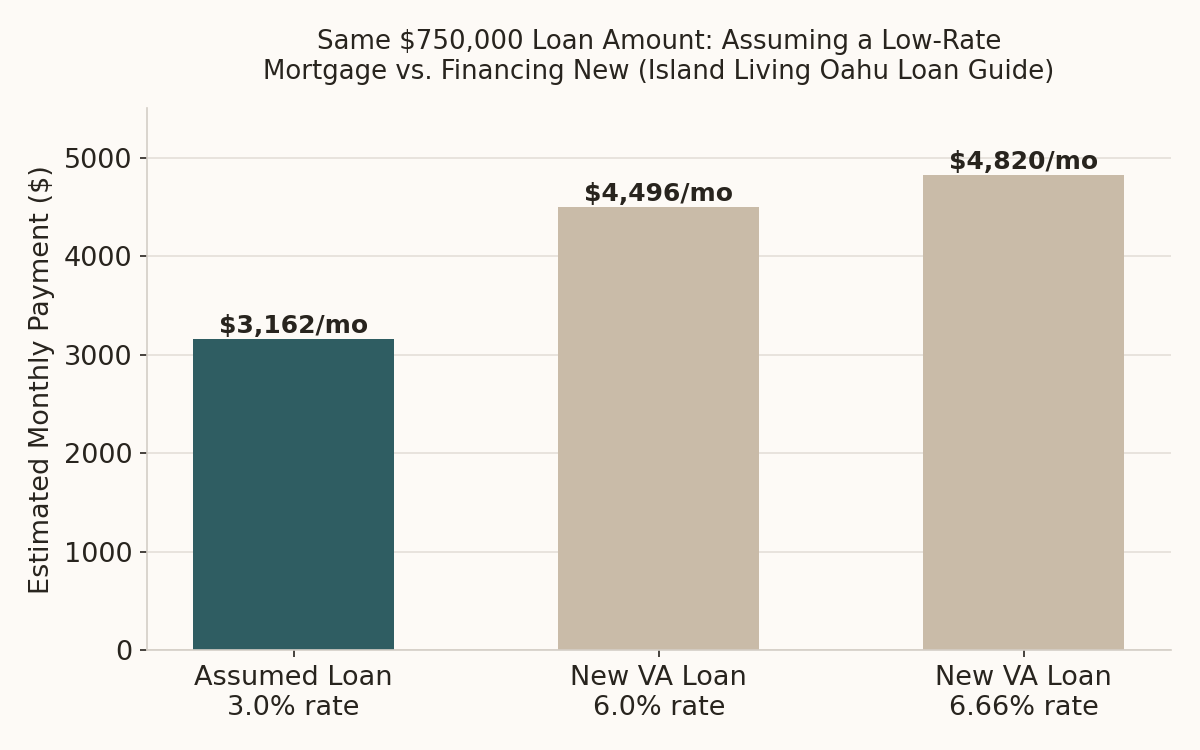
Using Aksana’s own Loan Assumption Guide as a real, worked example: on a $750,000 loan amount, an assumed rate of 3.0 percent runs about $3,162 a month in principal and interest. The exact same $750,000 financed new at 6.0 percent runs about $4,496 a month, and at 6.66 percent runs about $4,820 a month. That’s a swing of well over $1,300 a month, over $15,000 a year, on the identical loan amount, purely from which financing path you take.
There’s a second advantage specific to VA buyers here: the VA funding fee on an assumed loan runs about 0.5 percent, compared to 2.15 to 3.3 percent on a new VA loan. On a $500,000 loan, that’s roughly $2,500 assumed versus $10,750 to $16,500 new. The tradeoff is time: loan assumptions typically take three to six months to process, longer than a conventional purchase, so this path works best for a buyer with some runway before they need to close, not someone racing a hard PCS deadline.
Assumed vs. New: The Real Monthly Payment Gap
| Financing Path | Monthly Payment ($750K loan) | VA Funding Fee |
|---|---|---|
| Assumed loan, 3.0% rate | ~$3,162/mo | ~0.5% |
| New VA loan, 6.0% rate | ~$4,496/mo | 2.15%-3.3% |
| New VA loan, 6.66% rate | ~$4,820/mo | 2.15%-3.3% |
| Assumption processing time | 3 to 6 months (longer than a typical new purchase) | |
What this tells me as the numbers agent for military buyers on Oahu: your BAH rate is set for you by DTMO every year, but the financing path you choose is not — and on the same loan amount, that choice can matter more to your monthly budget than a full pay-grade promotion.
Frequently Asked Questions
Where do I find my exact current BAH rate for Honolulu?
The Defense Travel Management Office’s official BAH Rate Lookup tool is the only source that should inform your number — it calculates your specific rate by duty station, pay grade, and dependency status, and it’s updated annually.
Does my full BAH count toward what I can borrow for a mortgage?
Not automatically. BAH is one input your lender uses alongside your base pay, debt, and the specific loan program’s underwriting rules. It is not itself a pre-approval number, and DTMO is explicit that BAH isn’t designed to cover 100 percent of every service member’s housing cost in every market.
What happens to my BAH if rates drop after I’ve already PCS’d to Oahu?
Individual rate protection generally keeps you at your prior, higher rate as long as your dependency status and pay grade stay the same and you don’t PCS again — you won’t see a decrease mid-assignment.
Is assuming a seller’s loan always better than getting a new mortgage?
Not always — it depends on your timeline. Assumptions typically take three to six months to process, longer than a standard purchase, so they work best for buyers with some runway. But on the same loan amount, an assumed low rate can cut your monthly payment by well over a thousand dollars compared to financing new at today’s rates.
Can a non-veteran buyer assume a VA loan on Oahu?
Yes, VA loans can generally be assumed by qualified buyers regardless of veteran status, though the seller’s VA entitlement stays tied to that loan until it’s paid off unless the new buyer is also VA-eligible and substitutes their own entitlement. See Can You Assume a VA Loan on Oahu as a Non-Veteran Buyer? for the full breakdown.
Where This Leaves You
Your BAH number is only the starting point. The real question is what financing path gets you the most house for that number, and on Oahu right now, assumable low-rate loans are one of the biggest levers available to a military buyer.
Want every Oahu listing with an assumable loan, updated twice a month, so you can see exactly where a below-market rate stretches your BAH further? Get on the list at islandlivingoahu.com/assumable-list, and read the full mechanics of how assumption works in the Loan Assumption Guide.



