Quick Answer
What is the right order for clearing out a parent’s Oahu home when you live on the mainland?
Get your legal authority to act on the estate’s behalf first, before touching anything in the home. Then secure the property, notify the insurance carrier of the vacancy, sort contents remotely using photos or a trusted local point of contact, and only then move toward listing preparation. Doing these out of order, especially removing or selling belongings before you have authority, can create real problems with the estate.
By Aksana Tupalskaya | September 1, 2026
Losing a parent is hard enough without adding a five or six hour flight and a full house to sort through. Most of the stress in this situation comes from not knowing what order things need to happen in, not from the actual amount of work. Here is the order that avoids the most common mistakes.
Step one: get your legal authority before you touch anything
Before you remove belongings, change locks, or make any decision about the property, you generally need to be formally appointed as personal representative through Hawaii probate court, or otherwise have documented legal authority to act. This matters more than it might seem. Well-meaning heirs sometimes start clearing out a home before this step is complete, and it can complicate the inventory the personal representative is required to file, or create disputes with other heirs about what happened to specific items.
Step two: secure the property and notify your insurance carrier
Once you have authority, secure the home: change or re-key the locks, stop regular mail delivery or have it forwarded, and call the homeowner’s insurance carrier to report the property as vacant. This last step is easy to skip and important not to. Many standard homeowner policies limit or exclude coverage after a property sits vacant for 30 to 60 days, and a vacant-home policy or endorsement is usually available to keep coverage in place. Confirm this directly with the carrier rather than assuming the existing policy still applies.
Step three: identify one local point of contact
You do not need to be on-site to manage most of this, but having one reliable local point of contact makes everything faster: a real estate agent experienced with estate sales, a professional estate cleanout company, or a trusted friend or family member on the island. This person becomes your eyes and hands for anything that has to happen in person, from a video walkthrough to letting in a contractor.
Step four: sort contents without being there in person
A video walkthrough, room by room, lets you make keep, donate, sell, or discard decisions from the mainland with real information instead of guesswork. Estate sale companies and professional cleanout services handle the physical work and can often coordinate directly with your local point of contact, so a single in-person trip is not always necessary, though many heirs find one useful, especially for sentimental items that are hard to evaluate through a screen.
Step five: keep minimal utilities running
Turning everything off to save money is a common instinct, and it usually backfires in Hawaii’s climate. A closed-up home with no air circulation or dehumidification can develop mold and mildew problems within weeks, which cost far more to fix than the utility bill you were trying to avoid. Keep basic power running for a dehumidifier, a security system, and, if the home has one, minimal HVAC.
| Task | Typically Handled By | Rough Timing |
|---|---|---|
| Get appointed personal representative | You, with a probate attorney | Before anything else |
| Re-key locks, notify insurer of vacancy | You or your local point of contact | Within the first week or two of authority |
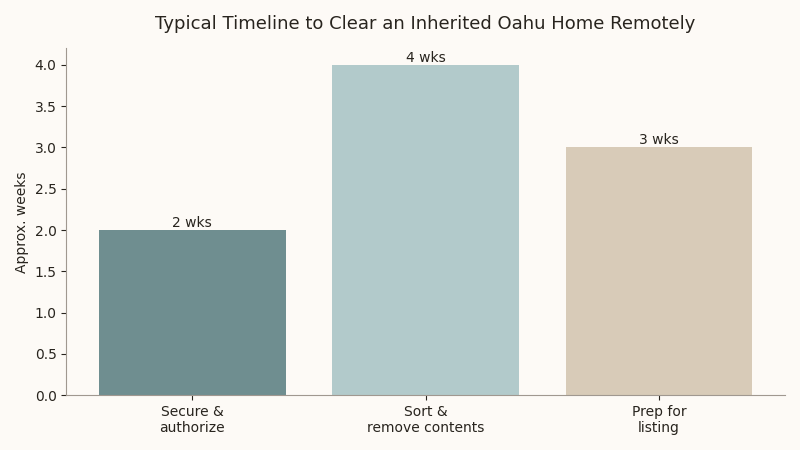
| Sort and remove contents | Estate sale company, cleanout service, or family with video walkthroughs | Several weeks, depending on the home’s contents |
| Light repairs and listing prep | Real estate agent’s recommended vendors | Before the home goes on the market |
What this tells me as the numbers agent for Oahu sellers: heirs who line up authority, insurance, and one local point of contact before they start sorting belongings consistently move faster than heirs who start with the physical cleanout and try to sort out the paperwork along the way.
Frequently Asked Questions
Do I need to fly to Oahu at least once during this process?
It is not always required, but many heirs find one trip useful, particularly for sorting sentimental items or making a final decision on repairs before listing. Whether it is necessary depends on how comfortable you are directing the process remotely and how much your local point of contact can handle.
What happens to belongings I can’t sort through remotely in time?
Estate sale companies and professional cleanout services routinely handle full-house cleanouts on a timeline, often photographing or setting aside anything that looks sentimental or valuable before disposing of the rest, so you are not forced to make every decision item by item.
Should I stop paying property tax and utilities while deciding what to do?
No. Property tax continues to accrue regardless of vacancy, and stopping utilities entirely creates the mold and humidity risk described above. Keep essential accounts active and current while the estate is being settled.
Can my real estate agent help coordinate the cleanout even before the home is ready to list?
Many agents who work regularly with estate sales are used to this and can recommend cleanout companies, contractors, and vendors, effectively serving as part of your local point of contact even before a listing agreement is signed.
If you are trying to sort out where to even start with a parent’s Oahu home from a distance, that first conversation does not have to wait until you have a plan. Book a free 20-minute strategy call here, or read about what actually costs you money each month the house sits empty here.