
Quick Answer
What does a personal representative actually pay to settle an Oahu estate through probate?
There is no fixed fee schedule in Hawaii the way some states have. Hawaii is what is called a reasonable compensation state, so both the probate attorney’s fee and the personal representative’s own fee are based on the time and complexity involved rather than a set percentage of the estate. For a straightforward estate, total probate costs, including the attorney, court fees, and the personal representative’s compensation, commonly fall somewhere between 3 and 7 percent of the estate’s value.
That is a wide range on purpose. The next sections walk through what actually moves a given estate toward the low end or the high end of it.
By Aksana Tupalskaya | October 22, 2026
Hawaii Doesn’t Use a Fee Schedule, It Uses “Reasonable Compensation”
Some states, California among the best known, set probate attorney fees by statutory formula: a fixed percentage of the estate’s gross value, tiered down as the estate gets larger. Hawaii does not work that way. Under Hawaii Revised Statutes Chapter 560, a personal representative is entitled to reasonable compensation for the work actually performed, and a probate attorney’s fee is set on the same reasonable basis rather than a formula.
In practice, that usually means the attorney bills by the hour, and the personal representative’s fee is either a flat amount the court approves as reasonable for the work involved, or an hourly rate if the personal representative is doing a meaningful amount of the administrative work personally. If you grew up hearing about a percentage-based probate fee from a mainland estate, that expectation does not transfer directly to an Oahu estate, and it is worth resetting it early.
What Actually Drives the Cost Up or Down
Because there is no formula, the honest answer to “how much will this cost” depends on a handful of real factors, not the size of the estate alone:
- Whether the estate is contested. A disagreement among heirs about the will, the valuation, or who should serve as personal representative adds attorney hours fast, and is the single biggest driver of cost beyond anything else on this list.
- How many assets, and what kind. One house and a bank account is a straightforward inventory. Multiple properties, a business interest, or assets spread across different states or countries all add administrative time.
- Whether a valid will exists. Administering an estate with a will (testate) generally moves more predictably than administering one without a will (intestate), where the court has to determine heirs under Hawaii’s intestacy statute first.
- Whether the estate qualifies for Hawaii’s simplified small estate or informal probate procedures, which run faster and cheaper than formal, supervised probate.
- Coordination across time zones and distance when heirs or the personal representative live outside Hawaii, which adds some overhead, though usually modest compared to the factors above.
What the Personal Representative Is Actually Being Paid For
The role carries real responsibilities: taking inventory of estate assets, notifying creditors, paying the estate’s valid debts and taxes, and eventually distributing what remains to the heirs under court supervision. I walk through the full scope of what a personal representative is actually obligated to do, in plain language, in a separate post on the role itself.
A personal representative who is also an heir, which is the most common situation, is still legally entitled to reasonable compensation for this work. Many family members choose to waive the fee or take a reduced amount, especially on smaller estates, but that is a choice, not a requirement. Either way, the court has to approve whatever compensation is actually paid before the estate is closed.
A Realistic Range, and Why It Stays a Range
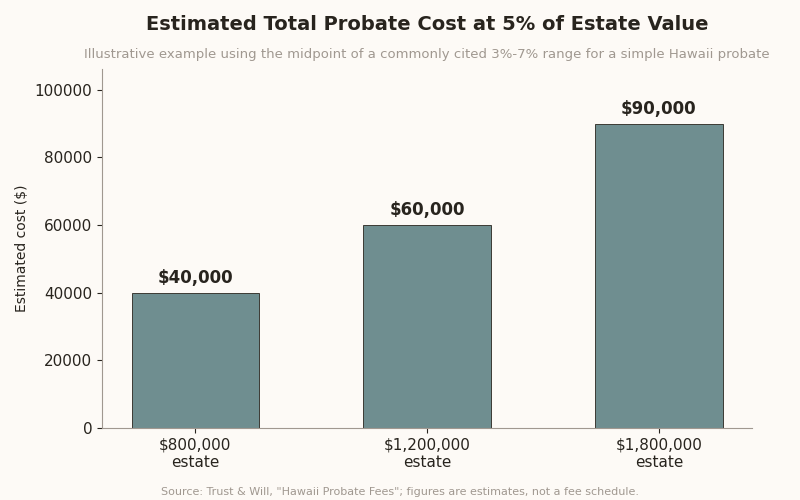
Because Hawaii’s standard is reasonableness rather than a formula, the most useful way to think about cost is as a range tied to the estate’s value, not a single number. Using the commonly cited 3 to 7 percent range for a straightforward, uncontested Hawaii probate, here is what that looks like at a few estate sizes, using the midpoint of that range as an illustrative total:
How long this process takes matters here too, since more time in probate generally means more attorney hours. I cover the actual timeline, and what sets the clock, in how long probate actually takes in Hawaii.
| Estate Value | Estimated Total Probate Cost (5% midpoint) | Range at 3% to 7% |
|---|---|---|
| $800,000 | $40,000 | $24,000 to $56,000 |
| $1,200,000 | $60,000 | $36,000 to $84,000 |
| $1,800,000 | $90,000 | $54,000 to $126,000 |
What this tells me working with out-of-state heirs: the dollar range widens fast as the estate grows, which is exactly why getting a specific attorney fee estimate early, rather than relying on a rule of thumb, is worth the phone call.
Two smaller costs sit on top of attorney and personal representative compensation: court filing fees, and in some cases a probate bond. A bond is a type of insurance that protects the estate if the personal representative mismanages assets, and the court can require one unless the will specifically waives it or all the heirs agree to waive it. Neither cost is large relative to attorney fees on a typical estate, but both are worth asking about up front rather than being surprised by them later.
If a personal representative or an heir ever disagrees with the attorney’s billed fee, Hawaii probate is court supervised specifically so that disagreement has somewhere to go: fees are submitted to the court for approval, heirs receive notice, and anyone can object before the court signs off. That oversight is part of why “reasonable compensation” works as a standard even without a fixed formula.
Frequently Asked Questions
Does the personal representative get paid even if they are a family member?
Yes, a family member serving as personal representative is still legally entitled to reasonable compensation. Many choose to waive the fee or take less than they are entitled to, particularly on smaller or simpler estates, but that is their choice, and the court still has to approve whatever is actually paid.
Is the probate attorney’s fee separate from the personal representative’s fee?
Yes. These are two separate reasonable-compensation determinations. The attorney is paid for legal work; the personal representative is paid for administering the estate. Both are paid from estate assets and both require court approval before the estate closes.
Can these fees be paid before the estate is fully distributed to the heirs?
Yes, fees are generally paid from estate funds as part of administration, before the final distribution to heirs, once the court has approved them. They are not something the personal representative or attorney pays out of pocket and waits to be reimbursed.
Does probate cost more when the heirs live out of state?
Usually only modestly more, through added coordination such as remote signing, document courier costs, or additional attorney time spent communicating across time zones. It is rarely the main driver of cost compared to whether the estate is contested or how many assets are involved.
Getting an Actual Number
A range is useful for planning, but the only way to get an actual number for a specific estate is to talk with a Hawaii probate attorney about the assets involved and whether anything about the situation is likely to be contested. That conversation is worth having early, not as a step you delay until you are already overwhelmed.
If you are an out-of-state heir trying to get a clearer picture of what an Oahu property is worth as part of that conversation, or you just have questions about where things stand, I am glad to talk it through. Book a free 20-minute strategy call: islandlivingoahu.com/strategy.