Quick Answer
What should sellers and buyers expect in the Kahala real estate market in 2026?
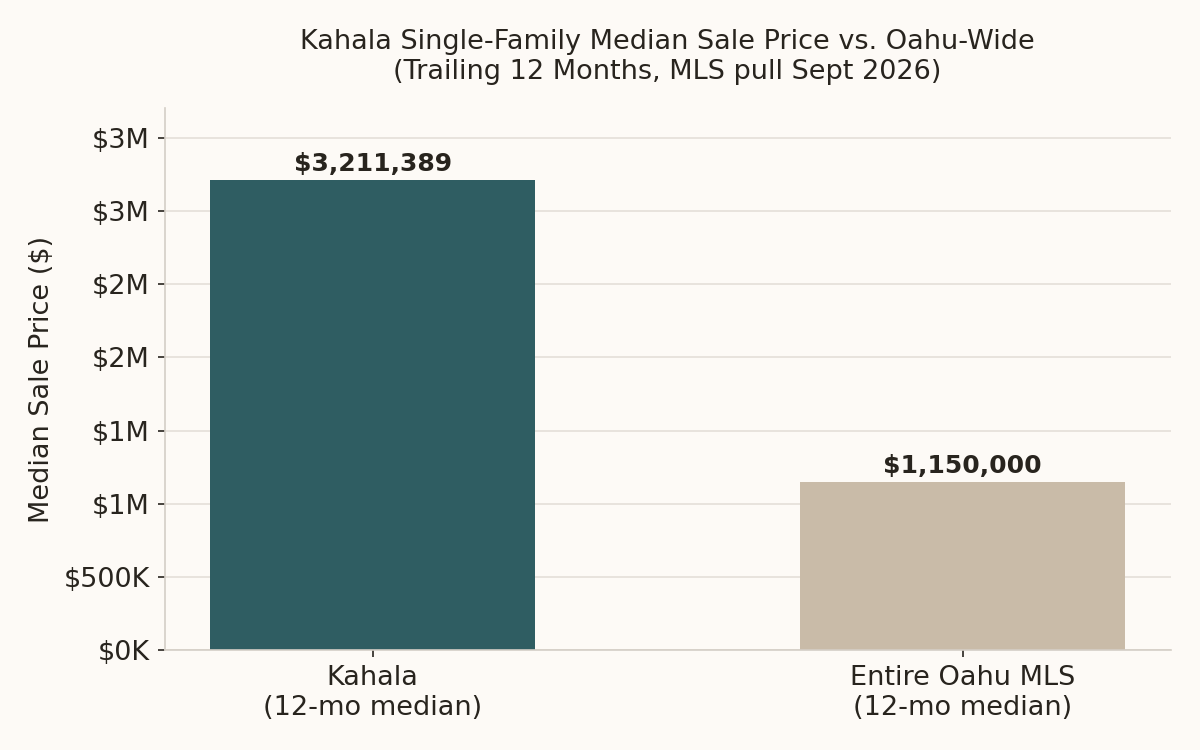
Kahala homes are closing at a median of roughly $3.2 million over the past 12 months, moving in a median of about three weeks, and selling for 97 to 100 percent of asking price. Disclosed seller concessions are rare and modest, typically $10,000 to $15,000 when they show up at all. That combination means sellers who price accurately still have real leverage, and buyers hoping for major negotiating room usually won’t find it.
By Aksana Tupalskaya | September 13, 2026
Kahala, tucked at the foot of Diamond Head and just minutes from Waikiki, is one of the most tightly held neighborhoods on the entire island. Roughly 1,300 properties carry the Kahala Area tax designation, and only a small slice of those change hands in any given year. If you’re thinking about listing here, or you’re a buyer wondering whether there’s any room to negotiate, the real numbers tell a clearer story than “it’s a hot market” ever could.
How Many Kahala Homes Actually Sell, and How Fast
Over the trailing 12 months, Kahala saw 32 single-family closings island-wide-scope and 19 closings under the exact MLS neighborhood tag, depending on which boundary you use. Either way, this is a thin-trading luxury pocket, not a high-volume subdivision. Closed sales were down double digits year over year, and there were zero closings in the single most recent month pulled — a reminder that any one-month snapshot in Kahala can be misleading. Trends here should be read across six and 12-month windows, not a single month.
What hasn’t slowed down is how quickly the homes that DO sell move. The median days on market over the past year sits at 22 days, roughly three weeks, actually down about 24 percent year over year. Months of supply runs at 4.4, which lands Kahala in balanced-market territory, not tipped hard toward buyers or sellers — if you want the full explanation of what that months-of-supply number actually means for your own timeline, see What Does Months of Supply Actually Mean for Your Oahu Home Sale?
Homes that sell in Kahala have closed at a median of 97.3 percent of list price over the past year, and in the six-month window that figure was a full 100 percent. That’s a market where accurate pricing gets rewarded quickly, and overpricing gets punished slowly. The homes that don’t sell tell that story even more clearly: in the trailing 365 days, 13 Kahala single-family listings came off the market without selling, at a median price nearly double what actually closed, and they sat a median of roughly five months before their sellers gave up and pulled them.
What Sellers Should Actually Expect on Concessions
This is the question most sellers actually care about: how much room do buyers expect to negotiate? Based on Aksana’s own MLS pull of the 19 confirmed Kahala closings this year, only three sales carried an explicitly disclosed concession figure at all, and two of those were disclosed as zero. The one disclosed dollar concession came in at $12,500 on a $2,600,000 sale, a little under half a percent of the sale price. The rest of the sold set shows no disclosed concession, which is not the same as zero — plenty of Hawaii sales simply don’t itemize a credit in the public record — but the pattern is consistent with what sellers should plan for: modest, occasional credits in the $10,000 to $15,000 range, not a routine giveback.
That’s meaningfully different from what a seller might assume from national headlines about buyers regaining leverage. In Kahala specifically, the sold data doesn’t support broad concession expectations. If you’re pricing a listing here, plan around a clean sale close to list price, not a negotiated discount baked in from day one.
What Buyers Should Actually Expect on Negotiating Room
If you’re a buyer hoping Kahala’s high price points mean more flexibility, the data says otherwise almost across the board. Active sold comps over the past year ranged from $1,925,000 up to $8,895,000, and homes across that entire range have been closing at or very near asking. The properties that show real price movement are the ones that come off market unsold and get relisted lower months later, not the ones that stay listed and eventually get a discount.
The honest takeaway for buyers: your leverage in Kahala comes from watching which listings go stale, not from negotiating hard on a well-priced new listing. A home priced in line with recent closings, in good condition, is very likely to sell at or close to its ask within about three weeks.
Kahala by the Numbers
| Market Indicator | Figure | Source / Timeframe |
|---|---|---|
| Median sale price, single family | $3,211,389 | My MLS pull (InfoSparks), trailing 12 months through Aug 2026 |
| Median days on market | 22 days | My MLS pull, trailing 12 months through Aug 2026 |
| Median percent of list price received | 97.3% | My MLS pull, trailing 12 months through Aug 2026 |
| Months of supply | 4.4 (balanced market) | My MLS pull, trailing 12 months through Aug 2026 |
| Largest disclosed seller concession | $12,500 on a $2.6M sale | My MLS pull, 19-sale sold set, trailing 365 days |
| 30-year fixed mortgage rate | 6.3% (national avg.) | Freddie Mac Primary Mortgage Market Survey, Sept 2026 |
What this tells me as the numbers agent for Oahu sellers: Kahala isn’t a market where you need to build a discount into your price to compete — it’s a market where accurate pricing gets rewarded within about three weeks, and the properties that sit are the ones priced ahead of where the neighborhood’s own closings actually land.
What This Means If You’re Deciding to List
If you own in Kahala and you’re weighing whether to list, the current numbers favor a well-prepared, accurately priced listing over waiting for a “better” market. With only about 10 active listings at any given time and 32 closings in the past year, there simply isn’t much competing inventory to get lost in. The risk isn’t a soft market — it’s mispricing into a thin one, where the wrong number can mean sitting for months instead of weeks.
Your own home’s condition, remodel history, and lot size will move your number more than any broad neighborhood average can. That’s exactly the kind of question a current market analysis answers, not a national headline — and if you’ve ever wondered whether an online estimate is even in the right neighborhood, see Why Your Oahu Home’s Zillow Estimate Is Probably Wrong.
Frequently Asked Questions
Is Kahala considered a buyer’s market or a seller’s market right now?
At 4.4 months of supply, Kahala is technically in balanced-market territory — not sharply tilted to either side. In practice, though, homes that are priced in line with recent closings are selling in about three weeks at 97 to 100 percent of asking, which behaves a lot like a seller’s market for well-priced listings.
How much negotiating room do buyers typically get in Kahala?
Very little on well-priced, recently listed homes. Of the confirmed sales in the past year, only a handful disclosed any seller concession at all, and the largest was $12,500 on a $2.6 million sale. Buyers looking for real price movement generally find it on listings that have already sat for months, not on new, accurately priced ones.
Is Kahala on the east side of Oahu?
No. Locally, “the east side” refers to the Windward side — Kailua, Kaneohe, Waimanalo. Kahala sits on Honolulu’s south shore, at the foot of Diamond Head and a short drive from Waikiki.
Why do so few Kahala listings come off market without selling if the neighborhood is balanced?
Actually, quite a few do — 13 single-family listings were cancelled or expired in the past year, priced at a median nearly double what actually closed. The lesson isn’t that Kahala is soft; it’s that overpriced listings in this neighborhood sit roughly five months before sellers give up, while accurately priced ones close in about three weeks.
How many homes are actually in Kahala?
Roughly 1,300 properties carry the Kahala Area designation in county tax records, across all property types. That scarcity is a big part of why so few homes trade here in any given year.
Where This Leaves You
Kahala rewards precision. The neighborhood’s own numbers, not a general Oahu headline, should set your expectations whether you’re listing or making an offer. Your specific number depends on your home’s condition, lot, and timing — that’s exactly where a current market analysis comes in.
Want to see what homes in this neighborhood actually sold for after credits, not just the recorded price? Get the free monthly sold report, including the seller credits the portals can’t show you, at islandlivingoahu.com/sold-report.