An accessory dwelling unit, an ADU, can be one of the more valuable additions to an Oahu property, whether the goal is rental income, multigenerational living, or simply more flexible space. It can also be one of the more common sources of a nasty surprise during a sale, when a buyer’s inspector or lender asks a question the seller was not expecting: is this actually permitted, and was it ever supposed to be?
Quick Answer
What actually makes an ADU legal on Oahu, and how long does permitting take?
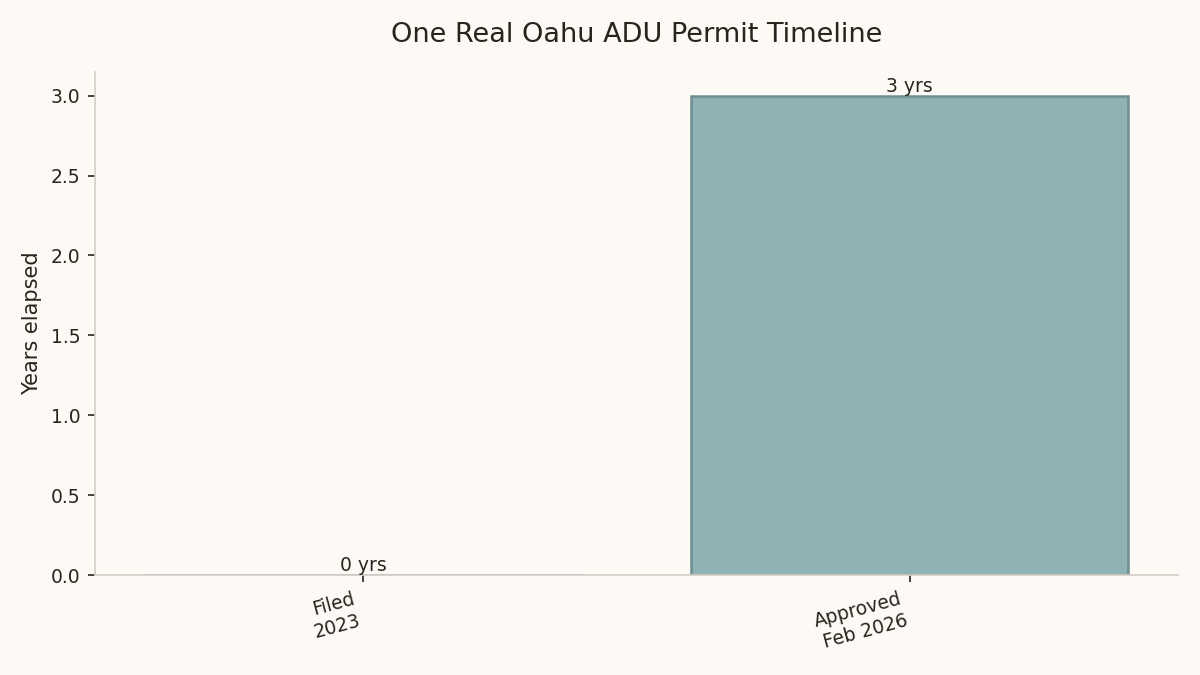
A legal Oahu ADU sits on a lot zoned R-3.5, R-5, R-7.5, R-10, R-20, or a Country District, and it has cleared the Honolulu Department of Planning and Permitting’s (DPP) building permit process, not just a construction job that looks finished. Since Ordinance 25-2 took effect on September 30, 2025, lot size is no longer the hard gate it used to be: a lot under 5,000 square feet can carry a detached ADU up to 500 square feet, and a lot of 5,000 square feet or more can carry one up to 1,000 square feet, even on lots smaller than the old 3,500 square foot threshold, provided the lot is not a CPR and the owner clears water, wastewater, driveway/traffic, and fire-access sign-off first. The permit has to be approved before the unit is legally built, not after. A recent Kuliouou example shows how long that approval alone can take in practice: permit filed in 2023, approved in February 2026, roughly three years.
By Aksana Tupalskaya | September 13, 2026
| What to check | Why it matters | Where to confirm it |
|---|---|---|
| Is the lot zoned R-3.5, R-5, R-7.5, R-10, R-20, or Country District? | ADUs are only allowed in these residential zoning districts on Oahu; other zones do not qualify at all | Honolulu DPP zoning maps, confirmed per parcel |
| Is there a DPP building permit on file for the ADU itself, not just a permit for the main house? | An unpermitted ADU is not legal no matter how finished it looks, and construction is only legal once the permit is approved, not once the unit is built | Honolulu DPP permit records |
| Is the lot a CPR (Condominium Property Regime)? | ADUs are not allowed on CPR’d lots, and a lot cannot be CPR’d once it has an ADU on it | County tax records / DPP |
| Does the proposed or existing ADU fit the size cap for the lot: 500 sq ft under 5,000 sq ft, or 1,000 sq ft at 5,000 sq ft and up? | Ordinance 25-2 (effective Sept 30, 2025) reset these caps and dropped the old blanket minimum lot size, so a pre-2025 assumption about what a lot could carry may now be out of date | DPP ADU size table, confirmed per parcel |
| Is there one off-street parking stall for the ADU, or a documented transit-proximity waiver? | One stall is required unless the lot is in the Primary Urban Center or Ewa Development Plan area and within 800 feet of a bus stop, with no prior ‘ohana parking adjustment used | DPP parking requirements, confirmed per parcel |
| Does the owner (or an immediate family member) actually live on the property, in either the main house or the ADU? | Hawaii’s ADU rules require owner-occupancy of the lot; an ADU rented out on a lot where the owner does not live raises a compliance question | DPP ADU application requirements |
What this tells me as the numbers agent for Oahu owners: the difference between an ADU that adds real value and one that creates a legal headache almost always comes down to whether it cleared DPP’s process, not how finished it looks or how long ago it was built.
What actually makes an ADU legal, not just built
A legal ADU on Oahu has to clear two separate tests: zoning eligibility and a completed permit. Zoning eligibility means the lot sits in one of five residential districts, R-3.5, R-5, R-7.5, R-10, or R-20, or in a Country District; ADUs are not permitted in other zoning classifications at all, regardless of lot size. The permit test means the Honolulu Department of Planning and Permitting has reviewed and approved the specific unit, with its own building permit on file, separate from whatever permit covers the main house.
Lot size used to be a hard line: DPP generally required a minimum lot area of about 3,500 square feet before an ADU could be considered at all. That changed with Ordinance 25-2, adopted by the City and County of Honolulu on January 3, 2025, with most provisions taking effect September 30, 2025. Under the current rules, a lot under 5,000 square feet can carry a detached ADU up to 500 square feet, and a lot of 5,000 square feet or larger can carry one up to 1,000 square feet, and DPP has confirmed that even lots smaller than the old 3,500 square foot threshold can now qualify for the smaller size, provided every other requirement is met. A property that was told “too small” under the pre-2025 rules may be worth a second look now.
There are two structural disqualifiers worth knowing regardless of lot size. First, a lot that is a CPR (Condominium Property Regime) cannot add an ADU, and a lot that already has an ADU cannot later be CPR’d. Second, the property must be owner-occupied: Hawaii’s ADU rules require the property owner, or an immediate family member, to actually live in either the main house or the ADU. An ADU used purely as a rental on an absentee-owned lot sits outside what the rules were built to allow.
Before design and drawings: the multi-agency sign-off most owners skip
Under Ordinance 25-2, owners are expected to file an ‘Ohana/ADU Pre-Form before paying for full architectural drawings. That Pre-Form routes to four separate agencies: the Board of Water Supply, for water service capacity; the Department of Environmental Services’ Wastewater Division, or the State Department of Health where an onsite system is involved; the Department of Transportation Services, for driveway and traffic questions where they apply; and the Honolulu Fire Department, for access and life-safety. If those agencies confirm capacity and access up front, the design phase proceeds with far fewer surprises later. If one of them flags an issue, an owner finds out before spending money on drawings that would need to be redone. Skipping this step does not make an ADU illegal by itself, but it is a common source of the mid-process delays covered below, because the same capacity questions get asked anyway, just later, after real money is already spent on plans.
Is a permit approved before construction, or after?
Before. A building permit has to be reviewed and approved before an ADU is legally built, the same way it works for any other structure on Oahu. An ADU built first and permitted later is, by definition, unpermitted construction for the period between when it went up and when (or if) it was ever brought into compliance.
Honolulu does allow an after-the-fact permit process for existing unpermitted work, including some ADUs, but it is not a shortcut and it is not free. It requires the owner to produce proper drawings of what was actually built, open up walls or finishes for inspection where needed, and bring the unit up to current code, sometimes with parts of it altered or removed if it turns out to violate a setback or exceed what the lot is allowed to carry. DPP also assesses a penalty on top of the standard permit fee. Oahu has one narrow amnesty-style path specific to older ADUs: units that were already built before September 14, 2015 may qualify for after-the-fact permitting under terms that do not apply to anything built more recently. An ADU built without a permit last year does not get the benefit of that older window.
The practical takeaway for a buyer, seller, or owner: “the ADU exists and looks finished” and “the ADU is legal” are two different facts, and only a DPP permit record settles the second one.
Why the timeline can run years, not months
Honolulu’s typical building permit turnaround has actually gotten faster over the past year. Citywide, the median wait for a new building permit fell to roughly two and a half months in the most recent reporting period, down about 40 percent from the same period a year earlier, largely credited to DPP’s newer CivCheck prescreening system, which has cut average residential review time from around 73 days to about 32 days for permits that clear it. That is the baseline for a straightforward, single-purpose residential permit moving through today’s process.
An ADU permit is a different animal, and the real Kuliouou example, filed in 2023 and approved in February 2026, about three years elapsed, shows why. That filing predates the CivCheck rollout (launched in 2025) and the size-and-lot-size relief under Ordinance 25-2, so it moved through the older, slower process. An ADU application also touches more reviewers than a typical single-family permit: water capacity, wastewater or onsite-system approval, traffic and driveway access where relevant, and fire access, on top of DPP’s own zoning and building-code review. Every one of those is a place a plan can get sent back for revisions, and each round of revisions restarts part of the clock. A change in the underlying ordinance mid-application, exactly what happened to any ADU permit filed before September 2025, can also mean re-checking a plan against rules that shifted while it was sitting in the queue.
The honest planning assumption for an Oahu ADU is a multi-year timeline from filing to approval, not a multi-month one, even though the citywide median for an ordinary permit has been improving. Treat the approval date as the real milestone. It is what a lender, an appraiser, and a future buyer’s inspector will all look for, not the date the framing went up.
Not every lot works the same way
Lot configuration still matters even after Ordinance 25-2’s relief on minimum lot size. A corner lot has made a legal ADU possible in cases where a similarly sized interior lot would not qualify the same way, largely because of how driveway and entrance access requirements interact with lot geometry, and because a corner lot often makes the required off-street parking stall easier to place without a variance. On a typical Oahu interior lot, the more common outcome is still one home plus whatever already exists, not an automatic third dwelling. That is not a rule against ADUs, it is a reason to confirm a specific parcel’s zoning, lot size, CPR status, and configuration with DPP before assuming a project that worked on a neighbor’s lot will work the same way on a different one nearby.
Why this matters most at resale
An unpermitted ADU does not necessarily stop a sale, but it does tend to surface, whether through an appraiser, a lender’s underwriting, or a buyer’s inspector asking where the second electrical meter came from. Sellers with an ADU on the property are better served knowing its exact permit status well before a listing goes live, rather than during escrow, since an after-the-fact fix under time pressure is slower and more expensive than confirming status early.
Where to confirm your own situation
This is general information about how ADU zoning, permitting, and timelines have worked on other Oahu properties, not a determination about your specific parcel. The Honolulu Department of Planning and Permitting is the direct source for zoning, lot configuration, CPR status, and permit history on any individual property, and a licensed contractor, architect, or permit expediter familiar with DPP’s current process, including the ‘Ohana/ADU Pre-Form, can help confirm what a specific project would actually require.
Frequently Asked Questions
How long does ADU permit approval actually take on Oahu?
It varies widely. Citywide, a typical residential building permit has recently been running around two and a half months thanks to DPP’s newer CivCheck prescreening process, but an ADU specifically touches more reviewers, water, wastewater or onsite systems, traffic, and fire access, on top of DPP’s own review, so real ADU timelines can run much longer. One recent Kuliouou example took roughly three years, filed in 2023 and approved in February 2026. Confirm current DPP processing times directly, since they vary by project, by agency workload, and by year.
What is the minimum lot size for an ADU on Oahu?
There is no longer a hard minimum. Under Ordinance 25-2, effective September 30, 2025, a lot under 5,000 square feet can carry an ADU up to 500 square feet, and a lot of 5,000 square feet or more can carry one up to 1,000 square feet, and DPP has confirmed lots smaller than the old 3,500 square foot threshold can now qualify for the 500 square foot size, provided every other requirement is met.
What zoning allows an ADU on Oahu?
R-3.5, R-5, R-7.5, R-10, and R-20 residential districts, plus select Country Districts. Other zoning classifications do not allow an ADU regardless of lot size. A CPR’d lot cannot add an ADU, and a lot with an ADU cannot later be CPR’d.
Is an ADU permit approved before or after it’s built?
Before, the same as any other structure on Oahu. Construction that happens before permit approval is unpermitted for that period. Honolulu does allow an after-the-fact permitting process for existing unpermitted work, with an inspection process and a penalty on top of standard fees, and one narrow amnesty-style path applies specifically to ADUs already built before September 14, 2015. It is not a path available for anything built more recently, and it is not a substitute for permitting before construction.
What makes an ADU “legal” rather than just built?
Two things together: the lot has to be zoned for it (R-3.5, R-5, R-7.5, R-10, R-20, or Country District, and not a CPR), and the specific unit has to have cleared DPP’s building permit process. A unit that looks finished, has its own driveway and entrance, or has been lived in for years is not automatically legal without that permit on file.
Does an unpermitted ADU affect a home sale?
It can. Lenders, appraisers, and buyers’ inspectors may all ask about permit status, and an unpermitted unit can complicate financing, valuation, or close a path to after-the-fact legalization if the lot or structure no longer meets current rules. Confirm a property’s permit history with DPP before listing.
If you’re weighing an ADU, or selling one
Whether you are considering adding an ADU or selling a property that already has one, confirming its zoning eligibility, lot size fit under the current rules, and permit status with DPP first can save real time and money later. I am glad to help you think through the resale side of that decision.
If you are weighing an ADU addition, evaluating a property that already has one, or want a second set of eyes on the resale math before you commit, book a strategy call and we will walk through it together.