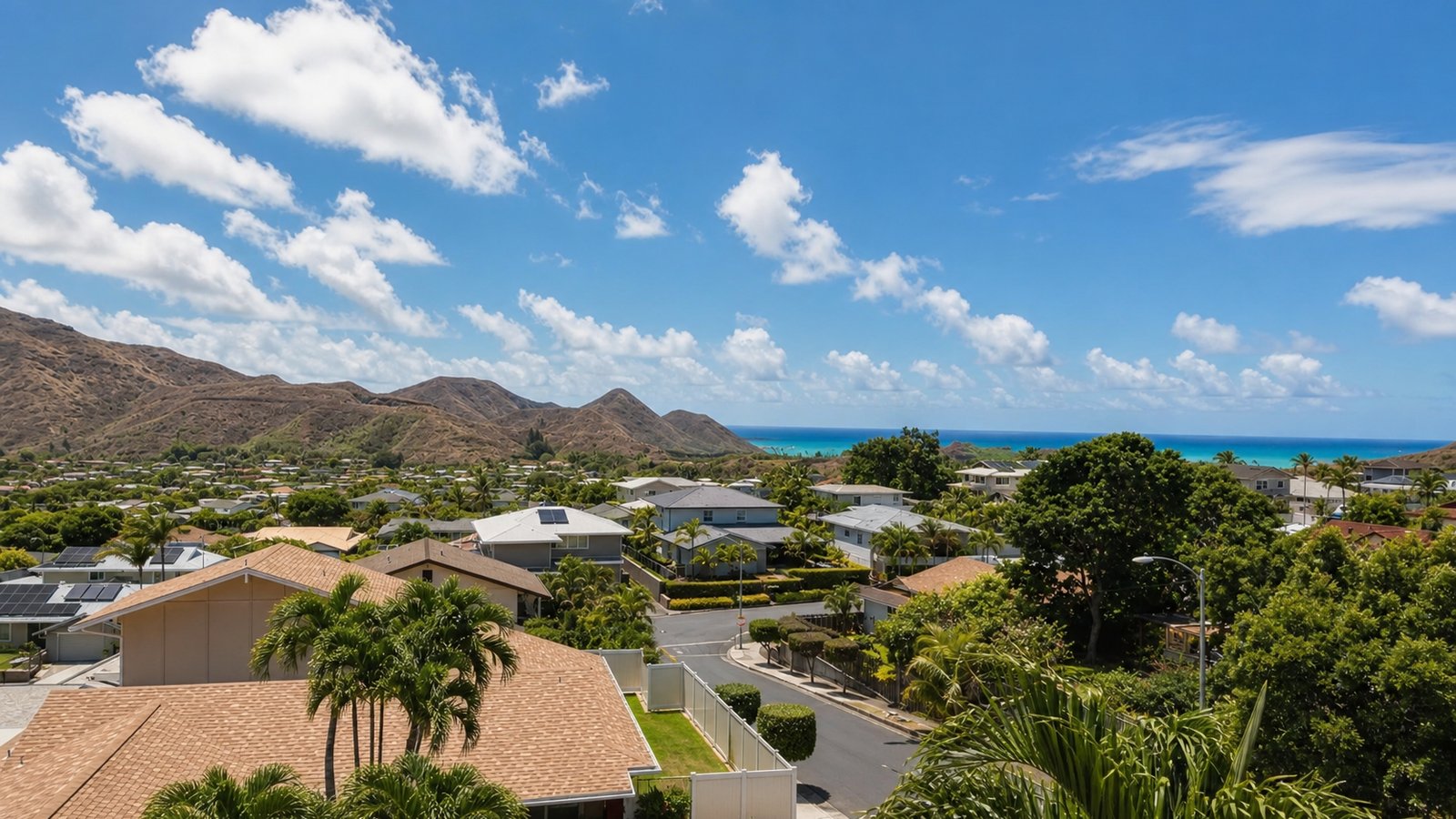

Four homes sit on one lot in Kaimuki, a four-unit CPR (Condominium Property Regime), all built in 2022 by the same builder, on the same floor plan, each holding an undivided 25 percent interest in the land underneath. On paper, they should be nearly identical to the county assessor. On the 2026 tax bill, they are not close.
The bill that should not exist, but does
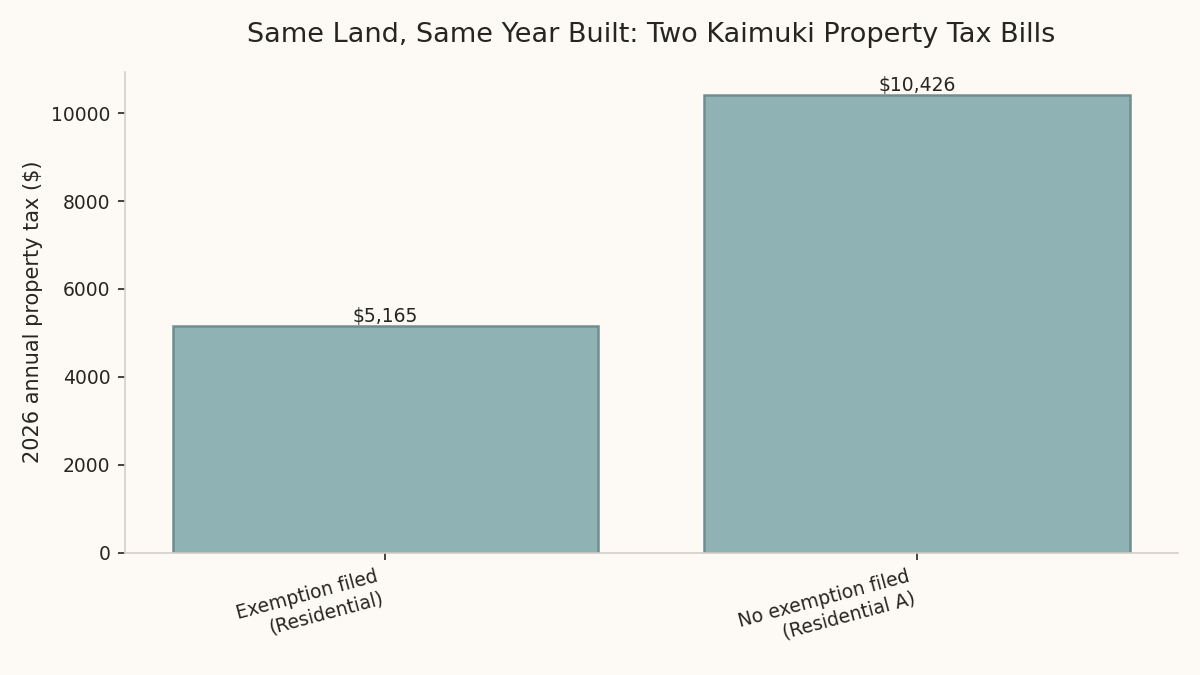
One of the four units is assessed at $1,595,800 and pays $5,165.30 a year in property tax. Another unit, assessed at $1,563,700, which is a lower value, pays $10,426.18, more than double. Same builder. Same year. Same lot. The higher-valued home pays less than half of what the lower-valued home pays.
The entire gap comes down to one thing: whether the home exemption is filed. The first unit has it. The second does not.
Quick Answer
How much does filing the Oahu home exemption actually save you?
On a four-unit Kaimuki property where all four homes were built together in 2022 by the same builder, the county’s own 2026 tax ledger shows one unit paying $5,165 a year and another, assessed for even more, paying $10,426. The only difference between them is that one owner filed the Honolulu home exemption and one did not. Filing removes $120,000 from your assessed value before tax is calculated, and it is also what keeps a home valued at $1,000,000 or more out of the higher Residential A tax class. The deadline to file for the coming tax year is September 30.
By Aksana Tupalskaya | September 12, 2026
| Kaimuki unit | 2026 assessed value | 2026 annual tax | Exemption on file? |
|---|---|---|---|
| Unit A | $1,595,800 | $5,165.30 | Yes — Residential, $120,000 exemption |
| Unit B | $1,563,700 (lower value) | $10,426.18 | No — Residential A, $0 exemption |
| Same lot, prior year (Unit A) | — | $9,710.26 in 2024 → $4,740.05 in 2025 | Bill roughly halved the year the exemption was filed |
| Approximate annual difference | — | about $5,900/yr for the unexempted unit | Residential A math: $4,000 + 1.14% of the excess over $1,000,000 |
What this tells me as the numbers agent for Oahu sellers: the exemption is not a rounding error. On a home valued near or above $1,000,000, filing one free form is worth thousands of dollars a year, every year you own it.
What the home exemption actually does
The City and County of Honolulu’s home exemption removes $120,000 from your assessed value before your property tax is calculated (or $160,000 if you are 65 or older). That alone is worth a few hundred dollars a year on a typical home. The bigger stakes show up once a property crosses $1,000,000 in assessed value.
A home assessed at $1,000,000 or more that does not have the exemption on file gets reclassified into Residential A, a separate and steeper tax tier. Filing the exemption is what keeps a property out of that tier entirely, regardless of value. That is the real lever behind the Kaimuki gap: it is not really a $120,000-deduction story, it is a which-tax-class-am-I-in story.
Two of the four Kaimuki units prove this on their own individual tax history, not just against each other. One unit’s own ledger shows its bill going from $9,710.26 in 2024 to $4,740.05 in 2025, cut by roughly half, with nothing renovated and nothing sold. The other shows a similar jump from $8,969.26 to $4,783.45 the year it filed. Same house, same owner, same year built. The only variable that moved was the exemption.
Why this catches people who assume they are covered
Nobody sets out to skip a free form. It happens in a handful of predictable ways:
- A recent purchase. The exemption does not transfer with a sale. The county removes the prior owner’s exemption at the point of transfer, and the new owner has to file fresh, in their own name, by September 30.
- A refinance, trust transfer, or name change on title. Any of these can knock an existing exemption off the record without the owner realizing it, because the property is still lived in exactly the same way.
- An investor or absentee owner assumption. A home with no exemption on file is not proof that nobody lives there. It just as often means an owner who has simply never filed.
The deadline, and what filing actually requires
The filing deadline is September 30, for the tax year that starts the following July. Missing it by even a day means paying the higher rate for a full year before the next window opens. Filing itself is a short form through the City and County of Honolulu’s Real Property Assessment Division, and it needs to show the home as your principal residence as of the assessment date.
Checking whether your exemption is currently on file takes a few minutes on the county’s own parcel lookup. If you have never checked, or you have refinanced, added someone to title, or moved a home into a trust in the last few years, that five minutes is worth more than almost anything else you could do with them this month.
Frequently Asked Questions
Does the home exemption come with the house when I buy it?
No. The county removes the prior owner’s exemption when ownership changes, and the new owner has to file a fresh claim in their own name by September 30 to have it in place for the next tax year.
What is Residential A, and how is it different from the standard exemption?
Residential A is a separate, higher property tax classification that applies to a home assessed at $1,000,000 or more with no home exemption on file. Filing the exemption keeps a property in the standard Residential class regardless of its value.
I already filed years ago. Could I have lost it without knowing?
Yes. A refinance, a trust transfer, or a name change on title can all remove an exemption from the county’s record. It is worth checking your parcel on the county’s own site rather than assuming a past filing still holds.
Does filing the exemption affect what my home is worth if I sell?
No, it has no effect on market value or a buyer’s offer. It only affects your own carrying cost while you own the home. It can matter to a buyer evaluating total ownership cost, since a buyer will need to file their own exemption after closing.
What to check this week
If you own and live in an Oahu home valued anywhere near $1,000,000, or you bought within the last year, or you have refinanced recently, confirm your exemption status on the county’s parcel lookup before September 30. This is not tax advice for your specific filing status; a CPA or the Real Property Assessment Division can confirm your individual situation.
I put together a short guide on how to check your exemption status and file before the deadline. Get the Oahu Home Exemption Guide here, and I will send it straight to your inbox.