
Quick Answer
What does it cost in property tax to run a legal short-term rental on Oahu?
Significantly more than a standard home. A property classified under Honolulu’s Transient Vacation tax class is taxed at $9.00 per $1,000 of assessed value on the first $800,000 and $11.50 per $1,000 above that, compared to $3.50 per $1,000 for a standard owner-occupied Residential property with the home exemption filed. On a $1,200,000 assessed home, that works out to roughly $11,800 a year in the Transient Vacation class versus about $3,780 with a home exemption in place, a gap worth weighing before you decide whether to keep renting short-term or sell.
By Aksana Tupalskaya | November 5, 2026
Why Almost No Oahu Property Actually Qualifies for Legal Short-Term Rental Tax Treatment
Before the tax rate matters at all, there is a more basic question: is the property even eligible for the Transient Vacation classification in the first place. The City and County of Honolulu’s rules, tightened under what is commonly called Bill 41, restrict legal short-term rental operation to buildings in the Resort Mixed Use zone, unless the unit holds a Nonconforming Use Certificate, or NUC, issued under the older rules.
Here is the part that surprises most owners researching this: the city has not issued a new Nonconforming Use Certificate since 1990. In practical terms, that means legal short-term rental status outside the resort zones is essentially closed to new properties. A handful of grandfathered nonconforming hotel buildings that were not originally built as hotels, but have operated around the clock under the current hotel definition, are carved out separately. Outside of those narrow categories, a property outside a resort zone cannot become a legal, tax-recognized short-term rental no matter how the owner wants to use it.
You do not have to take my word for which category your property falls into, and you should not. The City and County of Honolulu publishes its own map for exactly this question. On the Department of Planning and Permitting’s short-term rental page there is a tool labeled Check STR Eligibility, which lets you look up a specific property and see whether it sits in an area the city treats as eligible to register. A second map on the same page, the STR Compliance Map, shows properties that are actually registered to operate and properties that have been issued a notice of violation or order.
Two cautions on using it. What the map shows you is what the city’s records say about a parcel, which is not the same thing as a legal opinion about your property, and the city is the one that decides eligibility and issues registrations, not a map and not a real estate agent. And a parcel can sit inside an eligible area and still be blocked by its own building’s house rules or an association’s bylaws, which is a separate restriction that stops plenty of units the zoning would otherwise allow.
If what you actually want is the list of buildings, email me and I will send it. I keep a current list of the Oahu buildings and projects where short-term rental use is permitted, along with what is on the market in them, and working from that list is a great deal faster than checking a map parcel by parcel. Email me at [email protected] and tell me roughly what you are looking for. No cost and no obligation attached to asking.
What the Transient Vacation Tax Class Actually Costs
For the properties that do qualify, the tax cost is substantial. Using the City and County of Honolulu Real Property Assessment Division’s rate tables for the tax year beginning July 1, 2026, here is how the same $1,200,000 assessed home is taxed under three different classifications:
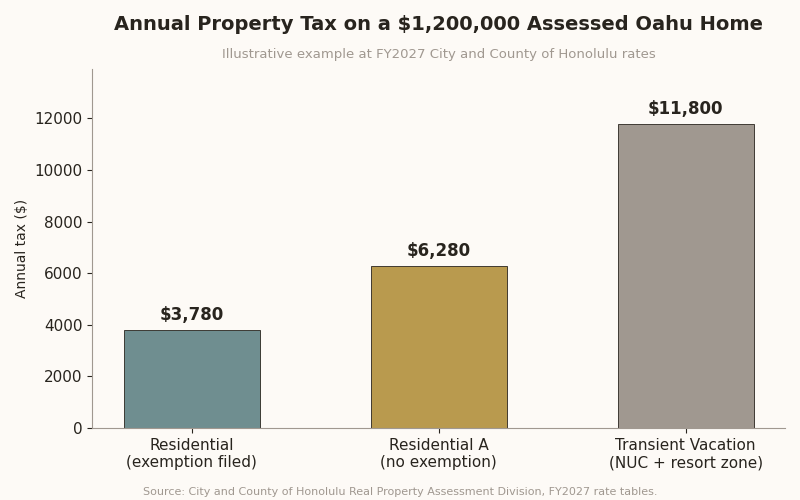
Residential A, the class that applies to a non-owner-occupied home worth $1,000,000 or more without a home exemption on file, already costs noticeably more than standard Residential. I cover the mechanics of that classification and its own worked examples in the other property tax filing most Oahu owners miss. Transient Vacation goes further still, because it is priced for a commercial-style use of the property, not simply an unoccupied or investment one.
What Happens If You’re Running an Unpermitted Short-Term Rental
This is where it is worth being precise about two separate questions that often get run together. One is which property tax class applies to your home. The other is whether operating a short-term rental there is legal under the city’s zoning rules at all. These are not the same question, and a favorable tax classification does not make an illegal rental legal.
A property outside a resort zone without a Nonconforming Use Certificate, being rented short-term through a platform, is operating in violation of the city’s zoning rules regardless of what property tax class it happens to be assessed under. The Department of Planning and Permitting enforces that separately, through fines that can be substantial and escalate for repeat violations, and tax classification is not a defense to that enforcement. If you are weighing whether an existing short-term rental arrangement on your Oahu property is actually permitted, that is a direct question for the Department of Planning and Permitting, not something to infer from a tax bill.
The Real Decision: Keep Renting, Convert to Long-Term, or Sell
For an owner who does hold a legitimate, permitted short-term rental, the Transient Vacation tax bill is simply one more cost to weigh against the income the property produces. For an owner whose short-term rental is not actually permitted, the honest comparison is different: converting to a long-term rental or selling removes both the zoning risk and, if a home exemption gets filed, meaningfully lowers the ongoing tax bill at the same time.
Either way, the numbers are the starting point for that decision, not the whole decision. What a property can actually rent for long-term, what it would sell for today, and what the tax bill looks like under each scenario all belong in the same conversation.
| Property Tax Class | Rate | Annual Tax on a $1,200,000 Assessed Home |
|---|---|---|
| Residential (home exemption filed) | $3.50 per $1,000 | ~$3,780 |
| Residential A (no exemption filed, $1M+ value) | $4.00 per $1,000 to $1M, $11.40 per $1,000 above | ~$6,280 |
| Transient Vacation (NUC + resort zone required) | $9.00 per $1,000 to $800K, $11.50 per $1,000 above | ~$11,800 |
What this tells me working with Oahu owners: the jump from Residential to Transient Vacation on the same home is over $8,000 a year, which means the tax class alone can be the deciding factor in whether a short-term rental actually pencils out.
Frequently Asked Questions
Is there a map where I can check whether my property qualifies?
Yes. The City and County of Honolulu’s Department of Planning and Permitting publishes a Check STR Eligibility map on its short-term rental page, where you can look up a specific property and see whether it falls in an area the city treats as eligible to register. The same page carries an STR Compliance Map showing which properties are registered and which have been issued a violation notice. The map reflects the city’s records rather than a determination about your particular property, and your building’s own rules can still prohibit short-term rental even where the zoning would allow it.
Can I just choose to be taxed at the Residential A rate instead of Transient Vacation?
No. Tax classification follows the city’s own determination based on zoning, permit status, and actual use, not an owner’s election. If the city determines a property is operating as a short-term rental, it can be reclassified regardless of what an owner would prefer to report.
Does listing on Airbnb or VRBO automatically trigger the Transient Vacation tax class?
Not automatically. Classification follows the city’s own review of zoning, permit status, and use, not the listing platform. Many unpermitted short-term rentals in non-resort zones exist as a zoning enforcement issue rather than a tax reclassification, though the city does periodically investigate and can both fine and reclassify a property it finds operating this way.
What is a Nonconforming Use Certificate, and can I apply for a new one?
A Nonconforming Use Certificate is the permit that allowed certain short-term rentals to continue legally outside resort zones under the city’s older rules. The city has not issued a new one since 1990, so in practice this path is closed for a property that does not already hold one.
If I stop running a short-term rental, does my property automatically return to the Residential tax class?
No, filing or refiling the home exemption is the mechanism that keeps or returns a property to standard Residential tax treatment, regardless of the property’s value. It is not automatic, and the filing deadline is September 30 for the tax year that begins the following July 1.
Running the Actual Numbers on Your Property
Every one of the figures in this post is an illustrative example at one assessed value. Your own property’s assessment, zoning, and permit status determine what actually applies to you, and the Real Property Assessment Division or the Department of Planning and Permitting are the direct sources to confirm them.
If you are weighing whether to keep an Oahu property as a rental or sell it, the place to start is what it would actually sell for today, including the real credits buyers are negotiating right now rather than a portal’s guess. Get the free monthly sold report for Kailua, Hawaii Kai, Diamond Head, and Ewa Plain at islandlivingoahu.com/credits.