
Most Oahu owners have heard that skipping the home exemption costs “a few hundred dollars a year.” That is true at the standard $120,000 deduction on a modest home. It stops being true the moment a home’s assessed value crosses $1,000,000, because an unfiled exemption at that point does not just lose you a deduction, it moves your entire home into a different, steeper tax class called Residential A.
Quick Answer
How much more property tax does Residential A actually cost you?
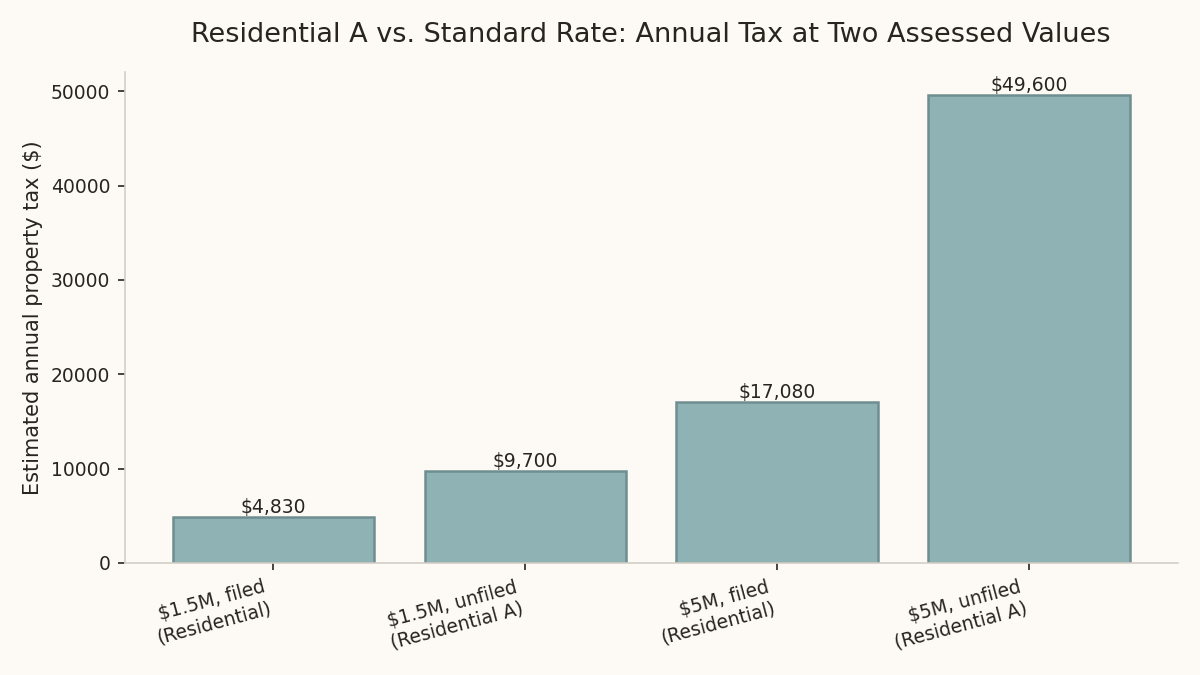
On a $1,500,000 assessed Oahu home with no home exemption on file, Residential A pushes the annual property tax to roughly $9,700, versus about $4,830 with the exemption filed, a gap of about $4,870 a year. On a $5,000,000 assessed home the gap widens to roughly $32,500 a year. The formula: standard Residential is a flat $3.50 per $1,000 of assessed value; Residential A charges $4.00 per $1,000 on the first $1,000,000 and $11.40 per $1,000 on everything above that.
By Aksana Tupalskaya | September 12, 2026
| Assessed value | Standard rate (exemption filed) | Residential A (no exemption) | Annual gap |
|---|---|---|---|
| $1,500,000 | ~$4,830/yr (taxed on $1.38M after $120K deduction, $3.50/$1,000) | ~$9,700/yr ($4,000 on first $1M + $5,700 on the $500K excess at $11.40/$1,000) | ~$4,870/yr |
| $5,000,000 | ~$17,080/yr (taxed on $4.88M after $120K deduction) | ~$49,600/yr ($4,000 on first $1M + $45,600 on the $4M excess) | ~$32,520/yr |
| Standard Residential rate | $3.50 per $1,000 of net taxable value | — | — |
| Residential A rate | — | $4.00/$1,000 (first $1M), $11.40/$1,000 (excess above $1M) | — |
What this tells me as the numbers agent for Oahu sellers: the higher your home’s assessed value climbs above $1,000,000, the more it costs to skip one free form, because the excess above $1,000,000 is taxed at more than three times the standard rate.
How Residential A is actually calculated
The trigger is simple: an improved residential property of no more than two units, or a condo unit, assessed at $1,000,000 or more, with no home exemption filed, gets classified Residential A instead of standard Residential. Vacant residential-zoned land at $1,000,000 or more qualifies too.
The rates for the current tax year (July 2025 through June 2026): standard Residential is a flat $3.50 per $1,000 of net taxable value. Residential A is a two-tier rate: $4.00 per $1,000 on the first $1,000,000 of assessed value, then $11.40 per $1,000 on everything above that. These rates are set annually by the City Council, so re-verify them before relying on a figure more than a few months old.
On a $1,500,000 assessed home with the exemption filed, the standard-rate math works out to roughly $4,830 a year. Without the exemption, the same home lands in Residential A at roughly $9,700 a year, once you run the two-tier formula. That is a gap of about $4,870, every single year the exemption stays unfiled.
Scale that up to a $5,000,000 assessed home, the kind of value common in Kahala, Diamond Head, and Kailua waterfront, and the gap widens to roughly $32,500 a year. The higher the value climbs past $1,000,000, the more painful the excess-tier rate becomes, because $11.40 per $1,000 is more than three times the standard $3.50 rate.
Why higher-value neighborhoods should care the most
It is tempting to assume Residential A mostly affects large, unusual properties. In practice it hits any Oahu home crossing the $1,000,000 assessed-value line, which now includes a large share of homes in Kahala, Diamond Head, Kailua, and increasingly Hawaii Kai and even parts of Central Oahu as assessed values have climbed. A home does not need to be a mansion to cross that line; it needs to be an ordinary home in a neighborhood where land alone now carries most of the value.
This is exactly why the math matters more in higher-value neighborhoods, not less. A buyer closing on a $2,000,000 Kailua waterfront home who assumes the seller’s tax bill will simply carry over, without filing their own exemption by September 30, is signing up for a materially larger bill than they expect.
What actually keeps you out of Residential A
There is only one lever: file the home exemption on the property where you actually live, by September 30, for the tax year that begins the following July. It does not matter how high the assessed value is. Filing keeps the property in the standard Residential class regardless of value. Missing the deadline means paying the higher rate for a full year before the next filing window opens.
This is informational, not individualized tax advice. Your own filing status, ownership structure, and any exemptions already on record should be confirmed with the Real Property Assessment Division or your CPA before you rely on any number here for your own return.
Frequently Asked Questions
What is the exact dollar line that triggers Residential A?
An assessed value of $1,000,000 or more, on an improved property of no more than two single-family units or a condo unit, with no home exemption filed. Vacant residential-zoned land at that value also qualifies.
Does Residential A apply if I live in the home full time?
Living in the home does not automatically protect you. The classification is driven by whether the exemption is filed, not by actual occupancy. An owner-occupant who has simply never filed the paperwork can still be classified Residential A.
Do these rates change every year?
Yes. The City Council sets Residential and Residential A rates annually, and they have moved in recent years. Always re-pull the current year’s rates from the Real Property Assessment Division before using them in a filing or listing decision.
If I just bought a home above $1,000,000, do I need to worry about this right away?
Yes. The exemption does not transfer with a sale, and the county removes the prior owner’s exemption at the point of transfer. A new owner has to file fresh, by September 30, to avoid a Residential A bill on their very first full tax year.
What to do with this before September 30
If your Oahu home is assessed anywhere near or above $1,000,000, confirm your exemption status on the county’s own parcel lookup rather than assuming it carried over from a prior year or a prior owner.
I put together a short guide covering exactly how to check your status and file before the deadline. Get the Oahu Home Exemption Guide here and I will send it straight to your inbox.