

Quick Answer
What happens when siblings who inherited one Oahu house want different things?
There are three real paths: one sibling buys out the others, the house is sold and the proceeds are split, or the siblings agree to rent it and split the income. Which one works depends on whether one heir can actually qualify for financing, whether the estate has cash for holding costs in the meantime, and whether every heir genuinely wants out. A written agreement among the heirs is what keeps any of the three from breaking down later.
By Aksana Tupalskaya | August 30, 2026
Why This Situation Is So Common on Oahu
An Oahu property that has been in the family for decades is often worth far more today than anyone expected when the original owner bought it. That is a good thing financially, and it is also exactly what turns a simple inheritance into a harder conversation. One sibling may see a house to keep. Another may see a property 2,500 miles away that needs a new roof and a property tax bill. Neither view is wrong, and disagreement at this stage is normal, not a sign that anything has gone wrong with the estate.
The good news is that co-heirs work through this every year, and there are only three real ways it ends.
The Three Ways This Usually Gets Resolved
Every version of this situation, however many heirs are involved, tends to collapse into one of three outcomes.
- One heir buys out the others. The heir who wants to keep the house pays the remaining heirs their share of its value, usually based on an independent appraisal, and takes sole ownership.
- The house is sold and proceeds are split. The property lists on the open market, sells, and the net proceeds are divided among the heirs according to the estate or the will.
- The heirs keep it together and rent it out. Nobody sells. The heirs become co-owners and, usually, co-landlords, splitting rental income and expenses by agreement.
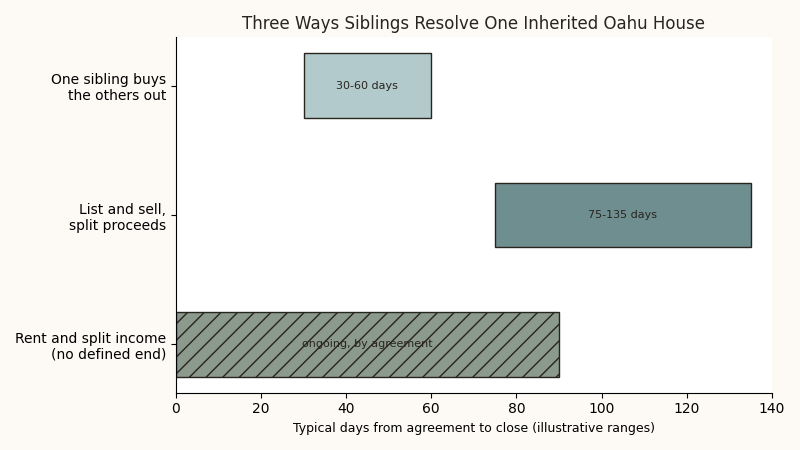
Below is how those three typically compare once the estate has cleared the legal steps needed to transfer or sell the property.
| Path | Typical Timeline | What It Requires | Best Fit |
|---|---|---|---|
| One sibling buys out the others | Roughly 30 to 60 days after everyone agrees | An independent appraisal, financing or cash from the buying sibling, and an attorney to document the buyout | One heir wants to keep the house and can actually qualify to pay the others their share |
| List and sell, split proceeds | Roughly 75 to 135 days from listing to close, once title is clear | Standard listing preparation, an agent, and closing costs split by agreement among the heirs | No heir wants to keep the house, or none can afford a buyout |
| Rent and split income | Ongoing, with no defined end date | A written co-ownership agreement, and a plan for who handles tenants, repairs, and disagreements later | Heirs want to keep the asset and are comfortable being long-distance co-owners together |
What this tells me, having walked clients through this: the option that looks most fair on paper is not always the one that works logistically, and that gap is exactly where a written agreement among the heirs matters most.
What Makes a Buyout Work, and When It Quietly Falls Apart
A buyout sounds like the cleanest option because only one heir has to change plans. In practice, it depends entirely on whether that heir can actually come up with the money. Financing a buyout on a paid-off inherited Oahu property usually means either qualifying for a new mortgage on the full value, or paying cash. Neither is automatic, especially if the buying sibling already owns a home elsewhere.
The other place a buyout stalls is the appraisal. Heirs sometimes assume the tax-assessed value or a Zillow estimate is close enough to work from. It usually is not, and using the wrong number is exactly the kind of disagreement that turns a simple buyout into a longer one. An independent appraisal, paid for by the estate or split among the heirs, gives everyone the same starting number to negotiate from.
If Nobody Wants to Keep It: Selling and Splitting Proceeds
When every heir would rather have the money than the house, selling is usually the simplest path, even though it takes longer than a buyout. The property still has to move through probate or trust administration before it can list, which is a separate timeline from the sale itself.
One detail heirs often get wrong here: because inherited property generally receives a stepped-up basis to its value at the date of death, the capital gains tax on a sale soon after inheriting is often much smaller than heirs expect, sometimes close to nothing. That is a separate question from HARPTA withholding, which can still apply at closing if an heir lives out of state, regardless of how little gain there actually is. Both are worth confirming with a CPA before anyone assumes what a sale will cost.
Renting Instead of Selling: The Option Nobody Asks About First
Some heirs, especially if the mortgage is paid off and the house is in reasonable condition, decide to keep the property and rent it out rather than sell. This is a real option, but it commits every heir to being a landlord together, indefinitely, from wherever they each live. That means agreeing in writing on who manages tenants, who approves repairs over a certain dollar amount, and what happens if one heir later wants to cash out while the others do not.
Renting is not a way to delay the decision. It is its own decision, and it works best when the heirs actually want to stay in business together, not when it is chosen simply to avoid choosing.
Where a Written Agreement Matters More Than the Path You Pick
The single thing that predicts whether any of these three paths goes smoothly is not which one the heirs choose. It is whether they put the agreement in writing before moving forward, including how disagreements later will be resolved. A verbal understanding among siblings who trust each other still benefits from being written down, because the people managing the details are often not in the same room, the same time zone, or even the same state.
Frequently Asked Questions
Can one sibling force a sale if the others disagree?
In many cases, a co-owner can petition a court for a partition action that forces a sale, but this is a last resort that costs time and money and often damages family relationships in the process. A probate attorney can explain what applies to your specific situation before it gets to that point.
Does it matter who is named personal representative?
Yes. The personal representative has the legal authority to manage and, in many cases, sell estate property, which is a different role from simply being an heir. If you are not sure who holds that role in your family’s situation, that is worth confirming with the estate’s attorney early.
What if one sibling lives on Oahu and the others do not?
This is common, and the sibling on-island often ends up handling the physical side, like meeting contractors or an agent, while the process itself still requires everyone’s agreement. A general power of attorney among the heirs can make day-to-day decisions easier without cutting anyone out of the bigger choices.
Do all heirs have to agree on the sale price?
Practically, yes, even if only one heir is legally required to sign. Starting from a neutral number, like an appraisal or an agent’s comparative market analysis, tends to prevent the price itself from becoming the argument.
If You Are in the Middle of This Right Now
None of this has to be resolved quickly, and there is no version of this article that should make you feel rushed. If it would help to talk through what a buyout, a sale, or a rental would actually look like for your family’s specific property, I am happy to walk through the numbers with you, at whatever pace works.
You can also see how Oahu probate generally moves in How Long Does Probate Take in Hawaii, and What Actually Sets the Clock?, and what HARPTA means for an inherited sale specifically in HARPTA and Inherited Oahu Property: The Trap Most Heirs Hit. For the fuller picture of the probate process itself, my guide to understanding probate in Hawaii walks through it start to finish.
If a conversation would help more than another article, a free 20-minute call is here: islandlivingoahu.com/strategy.