

Moving a parent into care is rarely a decision with a lot of spare attention left over for property tax paperwork. It is worth knowing, in the middle of everything else, that Honolulu’s home exemption does not automatically disappear just because the owner no longer lives in the house day to day.
Quick Answer
Does moving a parent into a care facility affect their Oahu property tax exemption?
In most cases, no. The City and County of Honolulu allows an owner who relocates to a care home or adult residential care facility to keep their home exemption in place through what the county calls a continuance. Two conditions apply: the facility has to be licensed to operate in the State of Hawaii, and the home cannot be rented, leased, or sold while the owner lives at the facility.
By Aksana Tupalskaya | September 12, 2026
| Situation | Does the continuance apply? | What the county requires |
|---|---|---|
| Parent moves into a Hawaii-licensed care facility, house sits empty | Yes | Nothing further, exemption continues under RPAD’s continuance provision |
| Parent moves into a facility outside Hawaii (e.g. to be near a mainland sibling) | No | RPAD’s own FAQ answers this directly: a facility not licensed in the State of Hawaii does not qualify |
| Family rents the house out while the parent is in care | No | The continuance does not allow the home to be rented, leased, or sold during that time |
| Temporary move for renovation, sabbatical, or fire (a related but separate continuance) | Yes, under a different form | Form BFS-RPA-E-8-10.3B, with a separate reoccupation form (E-8-10.3C) for returning home |
What this tells me as the numbers agent for Oahu owners: the relief here is real, and knowing the one thing it does not allow can prevent a well-intentioned decision from accidentally costing the exemption.
The relief: the exemption can stay in place
The City and County of Honolulu’s Real Property Assessment Division allows an owner who relocates to a care home or adult residential care facility to keep their home exemption through a provision the county calls a continuance. In practice, this means the property tax break that applied while your parent lived in the home does not have to end simply because they have moved into care.
The two things worth knowing
Two conditions determine whether the continuance applies.
The facility has to be licensed to operate in the State of Hawaii. RPAD’s own FAQ addresses this directly, and the answer is a flat no for a facility outside the state. If a parent moves to a facility on the mainland, perhaps to be closer to another sibling, the continuance does not apply the same way.
The home cannot be rented, leased, or sold while the owner lives at the care facility. A family weighing whether to rent out the empty house to help offset care costs should know this in advance: doing so can affect the exemption’s continuance, even if the intent is purely financial and temporary.
A separate but related continuance exists for a temporary move due to renovation, a sabbatical, or a fire, using form BFS-RPA-E-8-10.3B, with a reoccupation form, E-8-10.3C, for when the owner returns home. This is a different situation from a care home move, but families sometimes ask about it in the same breath.
Why this is worth checking, even quietly, in the background
On a long-held Oahu family home, especially one assessed at $1,000,000 or more, the stakes here go beyond the exemption’s standard value. A home that loses its exemption and crosses that assessed-value line can be reclassified into Residential A, Honolulu’s higher property tax tier, and the annual difference can run into the thousands of dollars. On an island where a long-held family home very often crosses that line, this is not a small detail.
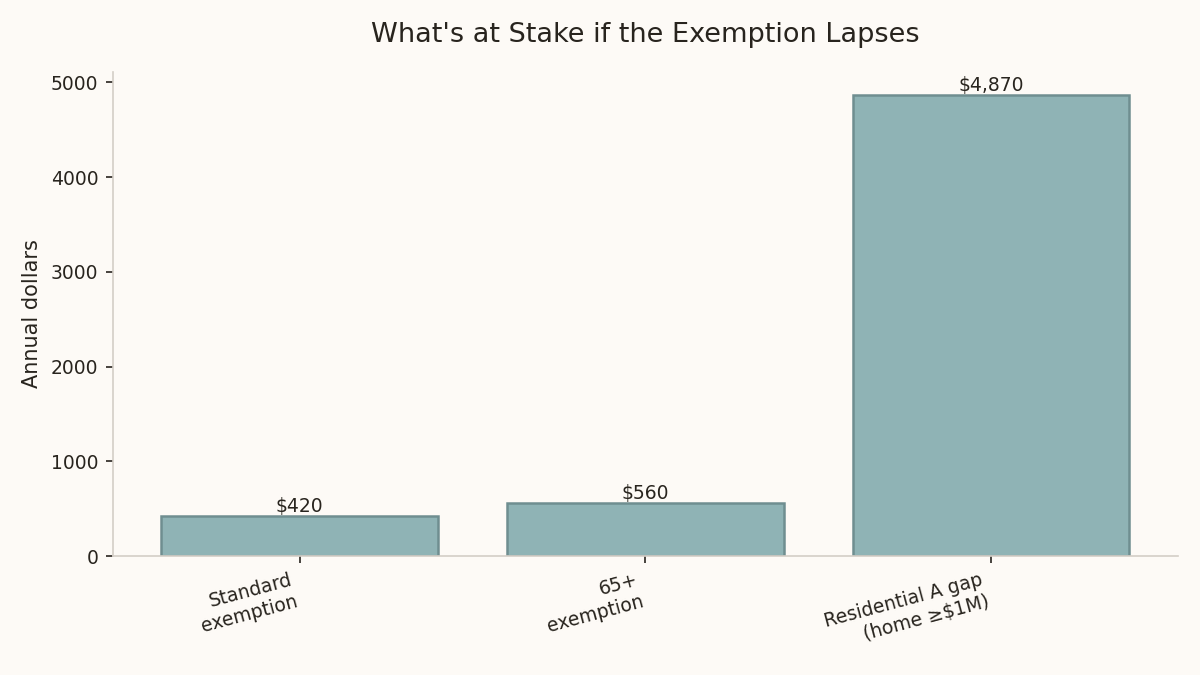
None of this needs to be sorted out immediately, or in the middle of an already difficult week. It is simply worth having on the list of things to confirm with the county once things settle, particularly if a sibling on the mainland and a sibling on Oahu are trying to coordinate what happens to the house.
Where this question actually gets answered
This is not legal or care-planning advice, and I am not the right person to guide a family through the broader decisions around elder care. For the property tax specifics, the Real Property Assessment Division is the direct source, and an elder-law attorney or care placement advisor familiar with your family’s situation can help with the decisions around it.
The part with a deadline: you still have to tell the county
One thing the continuance does not do is excuse the reporting. Honolulu puts that duty on the owner, and it applies to any change in status, including the one that eventually follows a move into care.
Under ROH section 8-10.1(d), an owner who has been allowed an exemption must report to the assessor within 30 days after the owner or the property stops qualifying, and no later than November 1. Filing that report is what voids the claim. Until it is filed, the exemption simply stays on the roll and the bills keep arriving at the owner-occupant rate.
That matters most at two moments. If the home is ever rented, leased, or sold during the care period, the continuance no longer applies and the change is reportable. And when the owner dies, the death itself is a reportable status change: the surviving title holder, a beneficiary, the trustee, or an authorized representative notifies RPAD, within 30 days and no later than November 1 of that year.
The penalty for missing it is $300, and RPAD’s materials state it applies for each year the change goes unreported, alongside the possible levy of taxes that should have been assessed and further penalties or interest. The form is the Change of Status, BFS-RPA-M-8-10.1. It is short, and filing it is the whole defense.
Added October 8, 2026. Reporting duty, deadlines, and penalty figures verified directly against the City and County of Honolulu Real Property Assessment Division. Confirm your own obligation with RPAD, since these are applied on the facts of each property.
Frequently Asked Questions
Does the exemption automatically continue, or does someone need to file something?
Confirm the specific filing requirement with the Real Property Assessment Division for your situation, since the continuance provision may require notification even when the underlying exemption itself does not change.
What if the care facility is just across the state line, still nearby?
RPAD’s own FAQ states that a facility must be licensed to operate in the State of Hawaii. Proximity to Hawaii does not change this requirement.
Can we rent out just a room in the house while our parent is in care, to help with costs?
This post does not have a verified answer to that specific scenario. Confirm directly with RPAD before renting any portion of the home while the continuance is in place.
What happens if we sell the house while our parent is still in care?
The continuance requires the home not be sold while the owner resides at the care facility. If a sale is being considered, confirm the exemption and continuance implications with RPAD before moving forward.
If this is where your family is right now
If you are in the middle of this decision with a sibling, this may be worth sending them, simply so the property tax piece is one less unknown in an already full plate. The Real Property Assessment Division can confirm your family’s specific situation.
If you want to see what the exemption is worth in dollars on a home like your parent’s, I worked through a real example in How Much Does the Oahu Home Exemption Actually Save You, and the higher-value case in What Does Residential A Actually Cost an Oahu Homeowner. If you are not sure whether the exemption is on file at all, my short guide shows how to check and how to file before September 30: get the Home Exemption Guide here. And if your family is weighing whether to keep or sell the house, I am happy to talk it through: book a 20 minute call.



